
In this article, you will learn how to design AI agents that can reliably self-correct by grounding their feedback loops in external verification rather than the model’s own judgment.

In this article, you will learn how to design AI agents that can reliably self-correct by grounding their feedback loops in external verification rather than the model’s own judgment.

Discover 7 chunking strategies for RAG pipelines and learn which approach fits your document type and query needs.

When you optimize the inference performance of an LLM, you need to know how to measure it. Without measurement, it is easy to make a model more complicated without making it faster, or to improve throughput while making user-visible latency worse. An LLM service has several kinds of performance. A user cares about how long […]
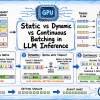
In this article, you will learn how static, dynamic, and continuous batching work in LLM inference, and why the differences between them matter at production scale.

A language model does not write text directly. Instead, it returns logits for the next token. The decoding algorithm decides how to turn those logits into a token, and repeating this decision produces the output text. The decoding algorithm affects the behavior of the model. Greedy decoding is deterministic and stable, but it can be […]

If you have implemented a transformer model in PyTorch, you can use the same code for both training and inference, but in very different ways. During training, you usually process a batch of fixed-length token sequences and update the model weights. During inference, the weights are fixed and the model generates new tokens one at […]

In this article, you will learn the seven architectural components that separate a production-grade agentic AI system from a demo script, and how each one fits into the agent’s core feedback loop.

Compare Ollama, LM Studio, and llama.cpp across five key dimensions to find the right local AI runtime for your workflow.
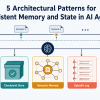
In this article, you will learn the five core architectural patterns for managing persistent memory and state in AI agents, and why treating them as deliberate design decisions is essential for production-grade systems.

In this article, you will learn how an agent’s approach to managing state — stateless or stateful — shapes both its implementation and the deployment architecture built around it.