
In this article, you will learn what tool calling and code execution are as agent action primitives, how they differ mechanically, and when to choose one over the other.

In this article, you will learn what tool calling and code execution are as agent action primitives, how they differ mechanically, and when to choose one over the other.

In this article, you will learn the mechanical difference between retrieval-augmented generation and fine-tuning, when each technique is the right tool, and how to decide which one, or both, your production system actually needs.

In this article, you will learn how to fine-tune an agentic AI system holistically, covering all four critical dials: training data, parameter-efficient fine-tuning, runtime hyperparameters, and preference alignment.

In this article, you will learn three concrete techniques for making machine learning model predictions interpretable, covering both global and local explanations across tree-based and neural network architectures.
In this article, you will learn how to design AI agents that can reliably self-correct by grounding their feedback loops in external verification rather than the model’s own judgment.

In this article, you will learn the seven architectural components that separate a production-grade agentic AI system from a demo script, and how each one fits into the agent’s core feedback loop.

In this article, you will learn what loop engineering is, where it came from, and how to design autonomous AI agent cycles that run reliably without constant human supervision.

In this article, you will learn how to evaluate LLM applications using the three dominant open-source frameworks — RAGAS, DeepEval, and Promptfoo — and why the LLM-as-a-judge mechanism they all rely on has measurable biases you need to actively design around.

In this article, you will learn how LangChain, LlamaIndex, and raw API calls each solve a different layer of the LLM application stack, and how to choose among them based on what your project actually requires.
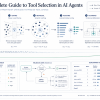
In this article, you will learn why agent accuracy degrades as a tool catalog grows, and six practical techniques for keeping tool selection accurate and efficient at scale.