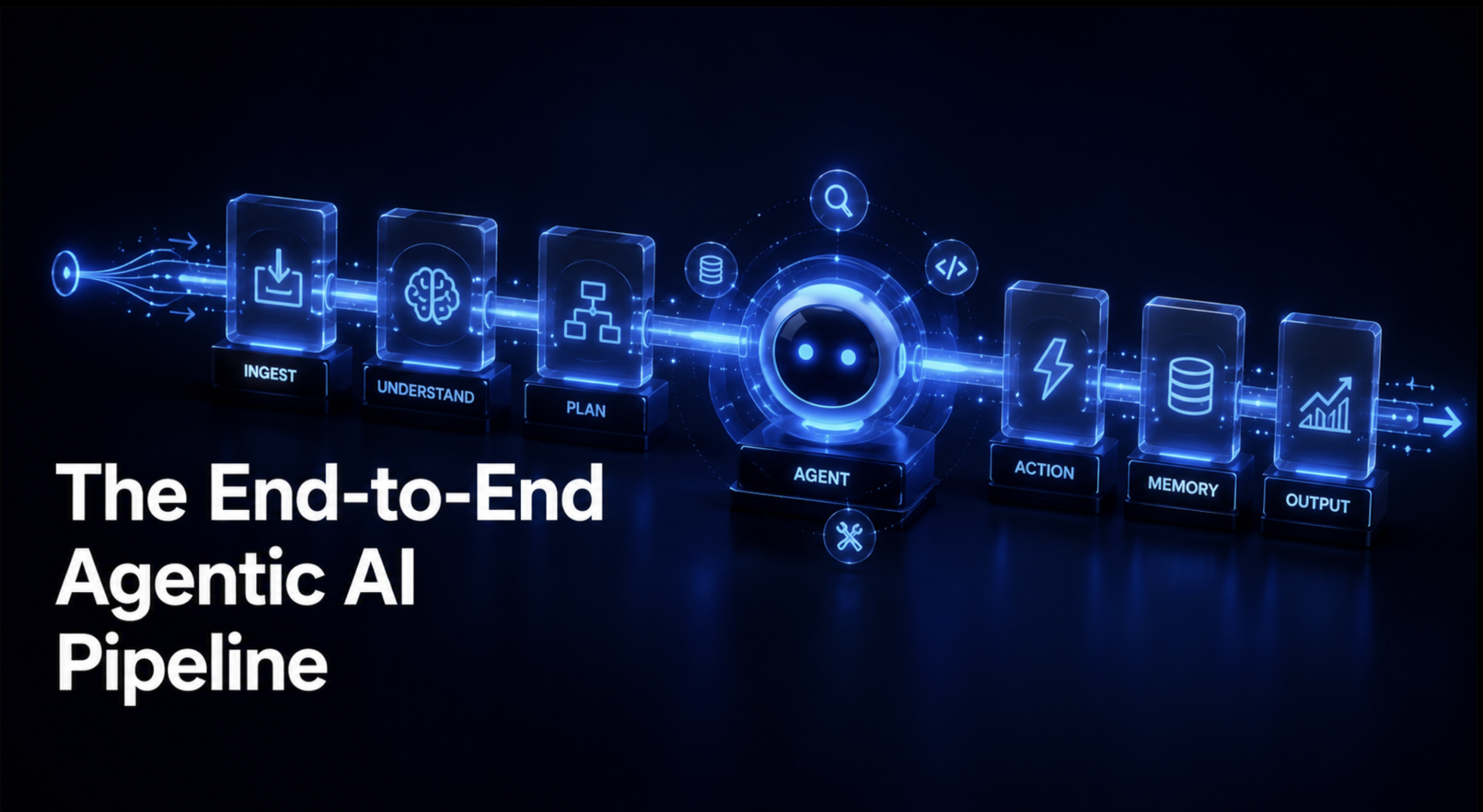
In this article, you will learn the seven architectural components that separate a production-grade agentic AI system from a demo script, and how each one fits into the agent’s core feedback loop.
Topics we will cover include:
What each of the seven components — perception, memory, reasoning and planning, tool execution, orchestration, guardrails, and observability — is specifically responsible for.
Where each component tends to break in real systems, and why that component must be kept separate from the others.
Focused, runnable Python code illustrating the responsibility of each component in isolation.
Introduction
Most “build an AI agent” tutorials show a 40-line script that calls an LLM in a loop and calls it done. That script works fine for a demo. It does not survive a second concurrent user, a flaky third-party API, or a task that turns out to need twelve steps instead of two.
The gap between the demo and the production system isn’t clever prompting. It’s architecture. Production agentic systems are built from a consistent set of interconnected components: perception, reasoning, planning, memory, tool execution, orchestration, and guardrails. That same component breakdown shows up across nearly every serious architecture writeup, survey paper, and production postmortem published in the last year, regardless of which framework or vendor is doing the writing.
The loop underneath all of it is consistent: Goal → Perception → Reasoning → Planning → Action → Observation → Memory Update → back to Reasoning, repeating until the goal is met, a stop condition fires, or the agent decides it needs a human. This article walks through each piece of that loop as its own component — what it’s responsible for, where it tends to break, and a focused code excerpt that makes the responsibility concrete. Nothing here is wired into one running pipeline. Each piece is shown in isolation, which is also how you should reason about your own system when deciding what it needs.
The Seven Components, at a Glance
Architectural surveys converge on the same core set: Perception, Memory, Reasoning/Planning, Tool Execution, and Orchestration form a closed feedback loop — the cycle that actually runs, step after step. Guardrails and Observability wrap around that entire loop as cross-cutting concerns rather than steps inside the sequence. You don’t “do” guardrails at step 4; guardrails sit between every proposed action and the world, watching every step.
That distinction shapes the rest of this article. The first five sections walk through the loop in the order data actually flows through it. The last two sections cover the wrapper layers that make the loop survivable once real money, real customers, and real side effects are involved.
Turning Raw Input Into Something the Agent Can Reason About
Perception’s job is to transform raw inputs — text, voice, API payloads, sensor data, and file uploads — into a structured representation that the reasoning engine can actually work with. This is the component most tutorials skip entirely, because in a demo, “the user just types text” and there’s nothing to normalize. Real systems take input from webhooks, structured API calls, file uploads, and multiple channels simultaneously, and every one of those needs to land in the same shape before anything downstream can trust it.
1
2
3
4
5
6
7
8
9
10
11
12
13
14
15
16
17
18
19
20
21
22
23
24
25
26
27
28
29
30
31
32
33
34
35
36
37
38
39
40
41
42
43
44
45
46
47
48
49
50
51
52
53
54
55
56
57
58
59
60
61
62
63
64
65
66
67
68
69
70
71
72
73
74
# perception.py
# Prerequisites: none beyond Python's standard library
# Run: python perception.py
from dataclasses import dataclass,field
from typing import Any
from enumimport Enum
import json
from datetime import datetime,timezone
classInputSource(Enum):
USER_TEXT="user_text"
WEBHOOK="webhook"
FILE_UPLOAD="file_upload"
@dataclass
classAgentInput:
"""
The normalized internal shape every downstream component consumes,
regardless of where the raw input actually came from. This is the
entire point of a perception layer: everything past this point
How to run: python perception.py, no dependencies required.
Three completely different raw shapes — plain text, a webhook JSON payload, and a file-upload event — all collapse into the same AgentInput structure. The reasoning component downstream never needs to know or care which channel something arrived through. That’s the entire value of treating perception as its own component rather than inlining ad hoc parsing wherever input happens to enter the system.
Working Context vs. What Actually Persists
This is the component with the most nuance, and the one demo code gets wrong most often by treating “memory” as just “the conversation so far.” Production memory architecture separates working memory — the immediate context window for the current task — from long-term memory, which itself splits into episodic memory (what happened), semantic memory (facts learned), and procedural memory (skills and how-to knowledge). Short-term memory lives in-context and is essentially free; long-term memory typically lives in a vector store, indexed for semantic retrieval rather than exact match.
The operational distinction matters: working memory is fast and disposable — it evaporates the moment the session ends. Episodic memory gives the agent something working memory structurally cannot provide: hindsight across sessions, the ability to recall “we handled something like this before, and here’s what happened.”
1
2
3
4
5
6
7
8
9
10
11
12
13
14
15
16
17
18
19
20
21
22
23
24
25
26
27
28
29
30
31
32
33
34
35
36
37
38
39
40
41
42
43
44
45
46
47
48
49
50
51
52
53
54
55
56
57
58
59
60
61
62
63
64
65
66
67
68
69
70
71
72
73
74
75
76
77
78
# memory.py
# Prerequisites: none beyond Python's standard library
# Run: python memory.py
from dataclasses import dataclass,field
from datetime import datetime,timezone
@dataclass
classWorkingMemory:
"""
Working memory: the immediate context for the CURRENT task only.
Lives in-process, bounded by a turn limit, and is gone the moment
the session ends. This is what most demo code calls "memory" --
print("\nEpisodic memory -- retrieved by similarity to a new refund query:")
forentry insimilar:
print(f" {entry.summary}")
How to run: python memory.py, no dependencies required.
Working memory drops its oldest turn once the limit is hit, and the first exchange about checking the status is gone by the end of the session. Episodic memory does the opposite: it surfaces the two refund-related episodes out of three stored entries, ranked by meaning, not by when they happened. That’s the structural line between the two — one is a sliding window, the other is a searchable archive.
Reasoning and Planning (Deciding What to Do Next)
Reasoning and planning take the current goal, the perceived input, and whatever memory was retrieved, and produce a plan — sometimes a single next action, sometimes a multi-step decomposition. This is the agent’s cognitive core, consulting memory and knowledge resources to synthesize action plans that get handed off to the execution module.
The critical design point, easy to miss: planning’s responsibility ends at producing the plan. It does not call a tool, touch an API, or have any side effects. That separation is deliberate, and it’s what makes the next component — tool execution — independently testable and independently guardable.
1
2
3
4
5
6
7
8
9
10
11
12
13
14
15
16
17
18
19
20
21
22
23
24
25
26
27
28
29
30
31
32
33
34
35
36
37
38
39
40
41
42
43
44
45
46
47
48
49
50
51
# planning.py
# Prerequisites: none beyond Python's standard library
# Run: python planning.py
from dataclasses import dataclass,field
import json
@dataclass
classPlanStep:
step_number:int
description:str
tool_tag:str# which category of tool this step will need -- execution decides HOW
@dataclass
classPlan:
goal:str
steps:list[PlanStep]=field(default_factory=list)
def mock_llm_plan(goal:str)->str:
"""
Mock LLM call standing in for a real planning call. The point being
demonstrated is structural: planning PRODUCES a plan object -- it does
not execute anything. Execution is a separate component (next section)
that the plan gets handed off to.
"""
if"refund"ingoal.lower():
returnjson.dumps({
"steps":[
{"step_number":1,"description":"Look up the order by ID","tool_tag":"database_lookup"},
{"step_number":2,"description":"Check refund eligibility against policy","tool_tag":"policy_check"},
{"step_number":3,"description":"Issue the refund if eligible","tool_tag":"payment_api"},
{"step_number":4,"description":"Notify the customer of the outcome","tool_tag":"email"},
]
})
returnjson.dumps({"steps":[
{"step_number":1,"description":"Search knowledge base for the answer","tool_tag":"search"},
]})
def create_plan(goal:str)->Plan:
"""Take a goal, produce a structured plan. Nothing here has a side effect."""
How to run: python planning.py, no dependencies required.
The refund goal produces a four-step plan; the business-hours question produces one. Neither call executed a single tool — both just returned a Plan object describing what should happen next. That object is the handoff artifact between reasoning and the rest of the pipeline, which is exactly why orchestration (covered later) can choose to pause, modify, or reject a plan before anything in it actually runs.
Tool Execution
Tool execution connects agents to external systems — APIs, databases, and services — handling the mechanics of invoking a capability and feeding the result back into the reasoning process. It’s also where most production incidents actually originate, because it’s the only component in the loop with real, external side effects.
The constraint is worth stating in plain numbers: at a 5% per-action failure rate, an agent taking 20 actions in a run will fail often enough to be unusable without guardrails. That single statistic is why tool execution can’t just be “call the API and hope” — it needs validation, a timeout, and idempotency as baseline requirements, not nice-to-haves.
1
2
3
4
5
6
7
8
9
10
11
12
13
14
15
16
17
18
19
20
21
22
23
24
25
26
27
28
29
30
31
32
33
34
35
36
37
38
39
40
41
42
43
44
45
46
47
48
49
50
51
52
53
54
55
56
57
58
59
60
61
62
63
64
65
66
67
68
69
70
71
72
73
74
75
76
77
78
79
80
# tool_execution.py
# Prerequisites: none beyond Python's standard library
# Run: python tool_execution.py
import time
import hashlib
from dataclasses import dataclass
from typing import Callable,Any,Optional
@dataclass
classToolResult:
success:bool
output:Any=None
error:Optional[str]=None
idempotency_key:Optional[str]=None
from_cache:bool=False
classToolExecutor:
"""
The non-negotiable basics for tool execution: validate inputs before
calling anything, enforce a timeout so a slow call can't hang the
whole run, and make side-effecting calls idempotent so a retry
doesn't double-charge a customer or double-send an email.
print(f"Retry, same args: from_cache={r2b.from_cache}, output='{r2b.output}'")
How to run: python tool_execution.py, no dependencies required.
The retry with identical arguments returns the cached result instead of calling issue_refund a second time. The customer gets refunded once, not twice, even if the orchestrator above it retries the step after a transient network blip. That’s the entire purpose of building idempotency into the execution layer rather than hoping the orchestrator never retries.
Orchestration
Orchestration holds the loop together across multiple steps and, in multi-agent systems, across multiple agents — deciding when to continue, when a step’s outcome should change the path, and when the run is actually finished. This is the layer that has matured fastest recently, with LangGraph, CrewAI, and AutoGen now handling production-grade coordination rather than every team hand-rolling their own loop from scratch.
1
2
3
4
5
6
7
8
9
10
11
12
13
14
15
16
17
18
19
20
21
22
23
24
25
26
27
28
29
30
31
32
33
34
35
36
37
38
39
40
41
42
43
44
45
46
47
48
49
50
51
52
53
54
55
56
57
58
59
60
61
62
63
64
65
66
67
68
69
70
71
# orchestrator.py
# Prerequisites: none beyond Python's standard library
# Run: python orchestrator.py
from dataclasses import dataclass,field
@dataclass
classPlanStep:
step_number:int
description:str
tool_tag:str
@dataclass
classPlan:
goal:str
steps:list[PlanStep]=field(default_factory=list)
@dataclass
classStepOutcome:
step_number:int
success:bool
output:str
# Stand-ins for the planning and tool-execution components above --
# orchestration's job is to CALL these in sequence, not do their work itself.
How to run: python orchestrator.py, no dependencies required.
Output:
1
2
3
4
5
6
7
Executing step1:Look up order
Executing step2:Check eligibility
Step2failed:Policy check failed:order too old
Stopping run--afailed step blocks the rest of thisplan
Total steps attempted:2
Finaloutcome:success=False,output='Policy check failed: order too old'
Step 3 — the actual refund — never ran. That’s not an accident of the mock; it’s the orchestrator doing its specific job. The planner produced a three-step plan with no knowledge of whether step 2 would succeed. The tool executor ran step 2 and reported failure. Deciding to stop there, rather than blindly continuing to issue a refund on an order that just failed eligibility, belongs to neither of those components — it belongs to orchestration.
Guardrails
Guardrails enforce the rules of the road: allow/deny lists for tools and domains, privacy and data-residency controls, cost ceilings, rate limits, and escalation paths for risky or irreversible actions. This isn’t a feature bolted on after launch; it’s the difference between an agent that’s impressive in a demo and one that’s safe to point at real customer accounts and real payment systems.
Current production guidance converges on the same core pattern: policy-as-code, mandatory approval gates for irreversible actions, and defenses against prompt injection where untrusted retrieved content could be mistaken for an instruction.
1
2
3
4
5
6
7
8
9
10
11
12
13
14
15
16
17
18
19
20
21
22
23
24
25
26
27
28
29
30
31
32
33
34
35
36
37
38
39
40
41
42
43
44
45
46
47
48
49
50
51
52
53
54
55
56
57
58
59
60
61
62
63
64
# guardrails.py
# Prerequisites: none beyond Python's standard library
# Run: python guardrails.py
from dataclasses import dataclass
from enumimport Enum
classGuardrailVerdict(Enum):
ALLOW="allow"
DENY="deny"
REQUIRE_APPROVAL="require_approval"
@dataclass
classProposedAction:
tool_name:str
args:dict
estimated_cost:float
irreversible:bool
@dataclass
classGuardrailResult:
verdict:GuardrailVerdict
reason:str
classGuardrailEngine:
"""
Sits between planning's proposed action and the tool executor.
Enforces an allow-list of permitted tools, a cost ceiling per action,
and mandatory human approval for anything irreversible -- regardless
of how confident the planner was that it was the right move.
payment_api->require_approval:Action isirreversible--requires human approval before execution
The last case is the one worth sitting with: a $49.99 refund, well within the $100 cost ceiling, still gets flagged for human approval because it’s irreversible — full stop. Being within budget doesn’t override that. This is exactly the kind of rule that’s trivial to write down and easy to skip if guardrails aren’t treated as their own component with their own checks, separate from whatever the planner decided was a good idea.
Observability
Observability means trace-level logging of every step — not just the final output, but tool choices and intermediate reasoning — because without traces you cannot debug or improve agent behavior. This is the component that turns “the agent did something wrong” into “the agent called policy_check at step 4, it returned success=False, and the orchestrator correctly stopped the run there.” That’s the difference between a system you can actually iterate on and one you can only restart and hope.
1
2
3
4
5
6
7
8
9
10
11
12
13
14
15
16
17
18
19
20
21
22
23
24
25
26
27
28
29
30
31
32
33
34
35
36
37
38
39
40
41
42
43
44
45
46
47
48
49
50
51
52
53
54
55
56
57
58
59
60
61
62
63
64
# observability.py
# Prerequisites: none beyond Python's standard library
How to run: python observability.py, no dependencies required.
find_failure_point() walks the trace and lands directly on the policy_check call at step 4 — the exact tool, the exact arguments, the exact reason it failed. No re-running the agent, no guessing which of five steps went sideways. That’s the practical payoff of treating observability as a structural component that wraps the loop, rather than scattering print() statements through the orchestrator and hoping they’re enough when something breaks at 2 AM.
Wrapping Up
None of these components is optional once a system leaves the demo stage, even though most tutorials only ever show two or three of them. Perception and memory feed the reasoning core. Reasoning and planning hand off a plan object to tool execution. Orchestration holds the whole sequence together across steps and decides when to stop. Guardrails and observability wrap the entire loop rather than sitting inside it — one constrains what the loop is allowed to do, the other records what it actually did.
The reason production agentic systems end up looking more like software architecture than prompt engineering is that, underneath the LLM calls, they genuinely are software architecture. The model is one component among seven that handles reasoning and planning — it’s not the entire system. Understanding each component’s specific, separate responsibility is what makes it possible to debug a failure, secure a risky action, and scale a pipeline past the second user, instead of just hoping the 40-line script keeps working.
Great overview of the “End-to-End Agentic AI Pipeline”! I liked how you broke down the key stages of building reliable AI agents from planning to execution. While exploring this topic, I also found this comparison of “AI Agents vs. Traditional Automation”: https://www.linkedin.com/pulse/ai-agents-vs-traditional-automation-understanding-key-zerkc/. It offers another practical perspective on where agentic AI delivers the most value. Looking forward to reading more of your insights!



Happy to learn
Great Article! 🙂
Happy to learn !!
Great overview of the “End-to-End Agentic AI Pipeline”! I liked how you broke down the key stages of building reliable AI agents from planning to execution. While exploring this topic, I also found this comparison of “AI Agents vs. Traditional Automation”: https://www.linkedin.com/pulse/ai-agents-vs-traditional-automation-understanding-key-zerkc/. It offers another practical perspective on where agentic AI delivers the most value. Looking forward to reading more of your insights!