
If you have implemented a transformer model in PyTorch, you can use the same code for both training and inference, but in very different ways. During training, you usually process a batch of fixed-length token sequences and update the model weights. During inference, the weights are fixed and the model generates new tokens one at a time.
This difference changes almost everything about performance. Training is dominated by large matrix multiplications and the backward pass. Inference is dominated by repeated forward passes, memory movement, and the need to keep previous attention keys and values available for the next token.
In this post, you will learn about:
- How autoregressive generation uses a prefill phase and repeated decode steps
- How a KV cache avoids recomputing earlier attention state
- How retained tokens determine KV cache memory use
Let’s get started.

Using a Transformer Model: From Training to Inference
Photo by Jacob Smith. Some rights reserved.
Overview
This post is divided into four parts; they are:
- Autoregressive Generation
- Prefill and Decode
- A Simple KV Cache
- Memory Usage of the KV Cache
Autoregressive Generation
A decoder-only transformer model predicts the next token from the tokens that came before it. The strict requirement of using only the previous tokens is enforced by the causal attention mechanism. If the input tokens are:
|
1 |
The cat sat on the |
the model returns a probability distribution over the vocabulary for the next token. A likely next token may be “mat”, but the model does not return a word directly. It returns logits, which are unnormalized scores for every token in the vocabulary.
The generation loop is therefore simple:
- Tokenize the prompt.
- Run the model to obtain logits for the next token.
- Choose a token from the logits.
- Append that token to the input.
- Repeat until a stopping rule is reached.
This is called autoregressive generation because each new token depends on the previous generated tokens. The model cannot generate the tenth output token before it knows the first nine output tokens.
A very small greedy decoding loop can be written as follows:
|
1 2 3 4 5 6 7 8 9 10 11 12 13 14 15 16 17 18 19 20 21 |
import torch @torch.no_grad() def greedy_decode(model, input_ids, max_new_tokens): output_ids = input_ids.clone() for _ in range(max_new_tokens): logits = model(output_ids) next_token_logits = logits[:, -1, :] next_token = next_token_logits.argmax(dim=-1, keepdim=True) output_ids = torch.cat([output_ids, next_token], dim=1) return output_ids class ToyModel(torch.nn.Module): def forward(self, input_ids): logits = torch.zeros(*input_ids.shape, 4) logits[..., 3] = 1.0 return logits print(greedy_decode(ToyModel(), torch.tensor([[0, 1]]), 3).tolist()) |
and the output will be:
|
1 |
[[0, 1, 3, 3, 3]] |
The toy model always favors token 3. A real causal language model supplies the logits instead. The loop feeds the entire sequence back into the model at each step; argmax() selects the highest-scoring token, and cat() appends it. The argument max_new_tokens must be positive for the loop to generate a token.
This code is easy to understand, but it repeatedly processes the whole prefix. For a prompt of $P$ tokens and $G$ generated tokens, it processes $\sum_{i=0}^{G-1}(P+i)=O(PG+G^2)$ token positions. Its attention-score work is $O(GP^2+PG^2+G^3)$ because each full forward pass attends over the growing sequence. These counts describe attention; the projections and MLP also cost time at every reprocessed position.
Inference systems mitigate this by splitting generation into two phases: prefill and decode.
Prefill and Decode
Generation usually begins with a prompt. The prompt is known before generation starts. The model can process all prompt tokens in one forward pass. This is called the prefill phase.
During prefill, the model computes hidden states for all prompt tokens and produces logits for the next token. It also computes keys and values for all attention layers. These keys and values can be saved because they will be needed by every future token.
After the first new token is selected, generation enters the decode phase. In decode, the model receives only the newest token. It computes the query, key, and value for that token, appends the new key and value to the cache, and attends the new query over all cached keys and values.
This changes the cost of one decode step. Instead of recomputing attention for the whole sequence, the model computes attention for only one new query against previous keys. The per-token attention-score cost changes from $O(N^2)$ to $O(N)$ for a sequence of length $N$. Across $G$ new tokens, attention-score work is $O(P^2+PG+G^2)$, including the initial prefill. The full transformer also performs projections and MLP work; a KV cache does not remove those operations for new tokens.
This distinction is important enough that serving systems usually measure prefill and decode separately:
- Prefill affects time to first token. A slow prefill increases time to the first token.
- Decode affects the speed of streaming output tokens. A slow decode reduces the rate at which output tokens are streamed.
A short prompt with a long answer stresses decode. A long prompt with a short answer stresses prefill. A chat application with a long conversation history stresses both.
The matrix below illustrates attention-score work. Assume the prompt has five tokens. During prefill, the model computes the causal part of the $5 \times 5$ prompt block in blue. During decode, each new token needs one new query row, shown in red. Black cells are masked by causality; earlier query rows are not recomputed.
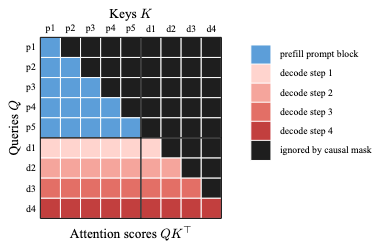
Prefill computes the prompt block once (blue). Each decode iteration computes only its new query row (red), including a score against the new key. The colored rows show work actually performed; no earlier query rows are recomputed.
A Simple KV Cache
The KV cache is where the model stores the attention keys and values produced by previous tokens. You can see how it works with a small model. The following code builds a small transformer-like model with a cache.
This model is not intended to produce useful text. Its purpose is to show how the cache is created during prefill and extended during decode.
|
1 2 3 4 5 6 7 8 9 10 11 12 13 14 15 16 17 18 19 20 21 22 23 24 25 26 27 28 29 30 31 32 33 34 35 36 37 38 39 40 41 42 43 44 45 46 47 48 49 50 51 52 53 54 55 56 57 58 59 60 61 62 63 64 65 66 67 68 69 70 71 72 73 74 75 76 77 78 79 80 81 82 83 84 85 86 87 88 89 |
import math import torch import torch.nn as nn import torch.nn.functional as F class SelfAttention(nn.Module): def __init__(self, hidden_size, num_heads): super().__init__() assert hidden_size % num_heads == 0 self.num_heads = num_heads self.head_dim = hidden_size // num_heads self.q_proj = nn.Linear(hidden_size, hidden_size) self.k_proj = nn.Linear(hidden_size, hidden_size) self.v_proj = nn.Linear(hidden_size, hidden_size) self.out = nn.Linear(hidden_size, hidden_size) def forward(self, x, past_kv=None): # Note: Positional encoding and padding masks are not implemented here batch_size, seq_len, hidden_size = x.shape q = self.q_proj(x).view(batch_size, seq_len, self.num_heads, self.head_dim) k = self.k_proj(x).view(batch_size, seq_len, self.num_heads, self.head_dim) v = self.v_proj(x).view(batch_size, seq_len, self.num_heads, self.head_dim) q, k, v = q.transpose(1, 2), k.transpose(1, 2), v.transpose(1, 2) if past_kv is not None: past_k, past_v = past_kv k = torch.cat([past_k, k], dim=2) v = torch.cat([past_v, v], dim=2) total_len = k.size(2) past_len = total_len - seq_len scores = q @ k.transpose(-2, -1) scores = scores / math.sqrt(self.head_dim) # A token may attend to all cached tokens and earlier tokens # in the current chunk, but not future tokens. causal_mask = torch.ones(seq_len, total_len, device=x.device, dtype=torch.bool) causal_mask = torch.tril(causal_mask, diagonal=past_len) scores = scores.masked_fill(~causal_mask, float("-inf")) attn = F.softmax(scores, dim=-1) y = attn @ v y = y.transpose(1, 2).contiguous().view(batch_size, seq_len, hidden_size) return self.out(y), (k, v) class Block(nn.Module): def __init__(self, hidden_size, num_heads): super().__init__() self.attn_norm = nn.LayerNorm(hidden_size) self.attn = SelfAttention(hidden_size, num_heads) self.ffn_norm = nn.LayerNorm(hidden_size) self.ffn = nn.Sequential( nn.Linear(hidden_size, 4 * hidden_size), nn.GELU(), nn.Linear(4 * hidden_size, hidden_size), ) def forward(self, x, past_kv=None): attn_out, new_kv = self.attn(self.attn_norm(x), past_kv=past_kv) x = x + attn_out x = x + self.ffn(self.ffn_norm(x)) return x, new_kv class TinyCausalLM(nn.Module): def __init__(self, vocab_size=128, hidden_size=64, num_heads=4, num_layers=2): super().__init__() self.token_emb = nn.Embedding(vocab_size, hidden_size) self.blocks = nn.ModuleList([ Block(hidden_size, num_heads) for _ in range(num_layers) ]) self.norm = nn.LayerNorm(hidden_size) self.lm_head = nn.Linear(hidden_size, vocab_size, bias=False) def forward(self, input_ids, past_kv=None): x = self.token_emb(input_ids) new_cache = [] if past_kv is None: past_kv = [None] * len(self.blocks) for block, layer_past in zip(self.blocks, past_kv): x, layer_cache = block(x, past_kv=layer_past) new_cache.append(layer_cache) logits = self.lm_head(self.norm(x)) return logits, new_cache |
The cache is a list with one element per transformer layer. Each element is a pair (k, v). The shape of each tensor is:
|
1 |
[batch_size, num_heads, sequence_length, head_dim] |
During prefill, sequence_length is the prompt length. During decode, the model receives one token at a time and appends one position to the cache.
Queries are consumed during the current forward pass; future queries never need earlier query vectors. Keys and values are reused by future tokens, so those are the tensors we cache. This teaching model omits positional information, so changing token order can leave its output unchanged. Real language models add position information and often use more efficient attention kernels.
The next script loads TinyCausalLM from the previous source file in the same directory, so you can run it directly. It uses the model’s cache interface:
|
1 2 3 4 5 6 7 8 9 10 11 12 13 14 15 16 17 18 19 20 21 22 23 24 25 26 27 28 29 30 31 32 33 34 35 36 37 38 39 40 41 42 43 44 45 46 |
from pathlib import Path from runpy import run_path import torch TinyCausalLM = run_path(str(Path(__file__).with_name("02_simple_kv_cache.py")))[ "TinyCausalLM" ] @torch.no_grad() def greedy_decode_with_cache(model, input_ids, max_new_tokens): output_ids = input_ids.clone() assert input_ids.size(1) > 0, "the prompt must contain a token" assert max_new_tokens > 0, "max_new_tokens must be positive" # Prefill: process the whole prompt once. logits, cache = model(input_ids) next_token = logits[:, -1, :].argmax(dim=-1, keepdim=True) output_ids = torch.cat([output_ids, next_token], dim=1) # Decode: process only the most recent token. for _ in range(max_new_tokens - 1): logits, cache = model(next_token, past_kv=cache) next_token = logits[:, -1, :].argmax(dim=-1, keepdim=True) output_ids = torch.cat([output_ids, next_token], dim=1) return output_ids model = TinyCausalLM() model.eval() prompt = torch.tensor([[10, 20, 30, 40]]) generated = greedy_decode_with_cache(model, prompt, max_new_tokens=8) print(generated) # Check that caching preserves this model's greedy output. def full_prefix_decode(model, input_ids, max_new_tokens): output_ids = input_ids.clone() with torch.no_grad(): for _ in range(max_new_tokens): logits, _ = model(output_ids) next_token = logits[:, -1, :].argmax(dim=-1, keepdim=True) output_ids = torch.cat([output_ids, next_token], dim=1) return output_ids torch.testing.assert_close(generated, full_prefix_decode(model, prompt, 8)) |
The model still produces one token at a time. The difference is that it no longer recomputes the prompt tokens after prefill. The key logic is in SelfAttention.forward(): when past_kv is provided, the method appends the new key and value to the cached tensors. During decode, the model processes only the most recently generated next_token rather than the entire sequence. This is the basic idea behind the KV cache in production inference engines.
Memory Usage of the KV Cache
The KV cache saves compute, but it consumes memory. For each token, each layer stores a key tensor and a value tensor. The approximate memory usage is:
|
1 2 |
bytes = 2 * num_layers * batch_size * sequence_length * num_kv_heads * head_dim * bytes_per_element |
The factor of 2 is for keys and values. The num_kv_heads value may be smaller than the number of query heads for models that use multi-query attention or grouped-query attention.
For a model with 32 layers, 32 KV heads, head dimension 128, BF16 cache values, batch size 1, and sequence length 4,096:
$$
\begin{aligned}
& 2 \times 32 \times 1 \times 4096 \times 32 \times 128 \times 2 \text{ bytes} \\
&= 2,147,483,648 \text{ bytes} \\
&= 2 \text{ GiB}
\end{aligned}
$$
This is only the KV cache for one request. It does not include model weights, temporary activations, tokenization buffers, or framework overhead. If the service handles many users concurrently, KV cache memory quickly becomes a limiting factor.
For this reason, an inference system must release KV cache memory when a request is finished. A simple script can let Python garbage collection handle this; a production server usually manages and reuses cache blocks explicitly. Finished requests may leave reusable prefix blocks in a shared cache until an eviction policy removes them.
The layout of the cache also matters. In the simple code above, each decode step appends tensors using torch.cat(). This is fine for teaching, but it is inefficient because it repeatedly allocates new tensors and copies old data. Real serving engines pre-allocate cache memory in advance or use a paged layout. Later posts will revisit this issue in detail.
Efficient KV-cache management is a major differentiator among inference systems.
Further Reading
Below are some resources you may find useful:
- Attention Is All You Need, by Vaswani et al.
This is the original Transformer paper. It introduces scaled dot-product attention, multi-head attention, and the query-key-value formulation used throughout this post. - Attention (machine learning), on Wikipedia.
This is a useful quick reference for the attention mechanism, including the formula $\operatorname{softmax}(QK^\top / \sqrt{d_k})V$ and the relationship between attention, self-attention, and the Transformer architecture. - Fast Transformer Decoding: One Write-Head is All You Need, by Noam Shazeer.
This paper introduces multi-query attention. It is directly related to inference because it reduces the amount of key and value data that must be read during incremental decoding. - FlashAttention: Fast and Memory-Efficient Exact Attention with IO-Awareness, by Dao et al.
FlashAttention is not only an inference algorithm; the original paper emphasizes faster Transformer training and memory-efficient exact attention. It is still relevant to inference because prompt prefill and long-context attention also benefit from reducing memory traffic and avoiding materializing the full attention matrix. - Orca: A Distributed Serving System for Transformer-Based Generative Models, by Yu et al.
This paper focuses on inference serving. It introduces iteration-level scheduling and selective batching, which are important ideas behind continuous batching for autoregressive generation. - Efficient Memory Management for Large Language Model Serving with PagedAttention, by Kwon et al.
This paper is directly about LLM inference serving. PagedAttention stores the KV cache in fixed-size blocks instead of requiring each request’s cache to be contiguous, reducing memory fragmentation and allowing larger batches.
Summary
In this article, you learned that inference is not just training without the backward pass. The model is used in a different pattern: one prefill step followed by many decode steps. The KV cache avoids recomputing attention keys and values for previous tokens, changing the per-token attention cost during decode from quadratic to linear in the sequence length.
You also implemented a simple KV cache in a tiny transformer model. This cache is the foundation for many later optimizations, including paged attention, continuous batching, prefix caching, long-context inference, and disaggregated prefill and decode.






No comments yet.