In this article, you will learn why agent accuracy degrades as a tool catalog grows, and six practical techniques for keeping tool selection accurate and efficient at scale.
Topics we will cover include:
Why adding more tools to an agent causes tool hallucination and accuracy loss, not just slower responses.
How gating, retrieval, routing, and planning each narrow down what the model sees before it has to choose a tool.
How to build fallback logic and a benchmark harness so you can measure whether any of these fixes actually worked.
None of this requires a bigger model, just a smarter view of what the model sees before it acts.
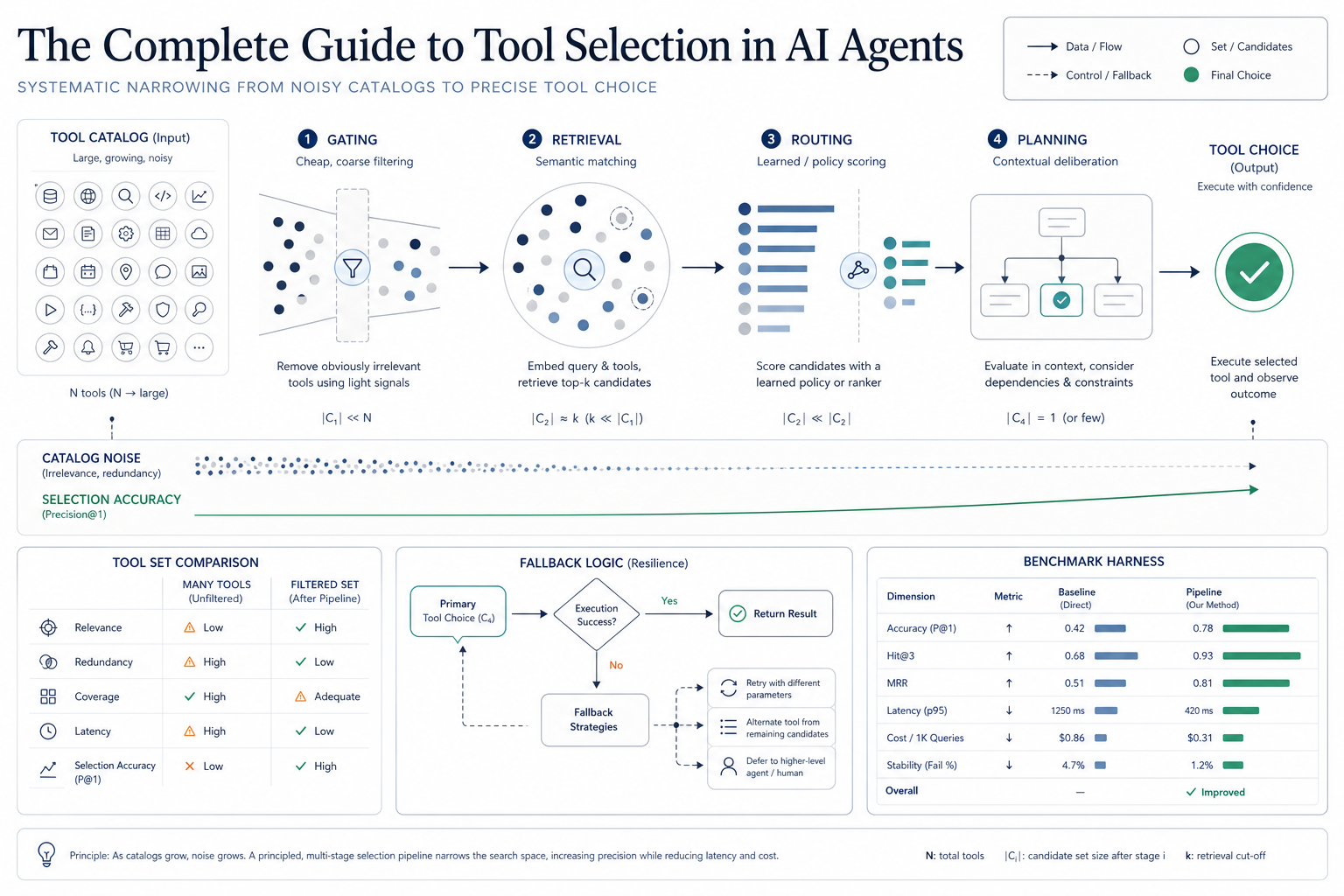
The Complete Guide to Tool Selection in AI Agents Click to enlarge
Introduction
You build an agent with five tools. It works flawlessly in the demo. Three months later, it has 40 file operations, CRM access, Slack, a calendar, and three different search APIs you bolted on for different teams. The same agent that nailed every demo now calls the wrong tool, hallucinates parameters borrowed from a different tool’s schema, or stalls mid-task waiting on a call that should never have been made.
Nothing about the model changed. The tool list did. This is not an edge case you’ll eventually run into. It’s the default trajectory of every agent that ships and then grows. Research analyzing MCP tool descriptions across the ecosystem has found that a high number contain at least one quality issue, and production benchmarks show agent accuracy degrading measurably once tool counts pass roughly 10 to 15. The RAG-MCP paper, published in May 2025, put hard numbers on the fix: retrieval-based tool selection more than tripled tool selection accuracy from 13.62% to 43.13% while cutting prompt tokens by over half on the same benchmark tasks.
Tool selection isn’t a minor implementation detail you patch later. It’s the architectural decision that determines whether an agent survives contact with a real tool catalog. This guide covers six techniques that solve it, in the order you’d actually deploy them: gating, retrieval, routing, planning, fallback logic, and the benchmark that tells you whether any of it worked.
Why Tool Selection Breaks at Scale
Every tool definition — its name, description, and parameter schema — gets sent to the model on every single request, whether that tool gets used or not. With 50-plus tools, this can consume 5 to 7% of the model’s context before the user’s actual message arrives, crowding out the conversation history and reasoning space the task actually needs.
The “lost in the middle” effect compounds this. Models recall information at the start and end of a context window far more reliably than information buried in the middle. With dozens of near-identical tool definitions stacked in sequence, the one tool that’s actually right for the job often sits exactly in that dead zone, overlooked not because the model can’t reason about it, but because attention is structurally pulled elsewhere.
The second failure mode is worse: tool hallucination. When an LLM’s attention spreads across too many similar-sounding tools, it either invents tool names that don’t exist or calls the correct tool while filling in arguments borrowed from a different tool’s schema. This is a hard failure. There’s no “slightly wrong” way to call a nonexistent function.
OpenAI documents a hard ceiling of 128 tools per agent, but real degradation shows up well before that limit; most production teams see accuracy drop noticeably once they cross 15 to 20 tools in active rotation. The fix isn’t a bigger context window. It’s controlling what the model sees in the first place.
Gating: Deciding Whether a Tool Is Needed at All
Before you optimize which tool to pick, ask a cheaper question first: does this turn need a tool at all? A meaningful fraction of agent turns are purely conversational: “thanks,” “what do you mean by that,” a follow-up clarification. Running full retrieval and tool-selection reasoning on every single turn means paying the full agentic overhead even when the answer is “no tool needed.”
A gate is a fast, cheap classifier — sometimes a small model call, sometimes just pattern matching — that runs before anything expensive does.
1
2
3
4
5
6
7
8
9
10
11
12
13
14
15
16
17
18
19
20
21
22
23
24
25
26
27
28
29
30
31
32
33
34
35
36
37
38
39
40
41
42
43
44
45
46
47
48
49
# gate.py
# Prerequisites: none beyond Python's standard library (re)
This costs almost nothing and catches a meaningful share of turns before they reach the expensive part of the pipeline. The threshold for “is this worth building” is low: if even 20–30% of your turns are conversational, gating pays for itself immediately in both latency and token cost.
Retrieval-Based Tool Selection
This is the technique with the strongest published evidence behind it. Instead of sending every tool definition on every call, you index tool descriptions in a vector store, embed the incoming query, retrieve only the top-K most relevant tools, and send just those to the model.
The RAG-MCP framework is the reference implementation of this idea, using semantic retrieval to identify the most relevant MCP tools for a query before the LLM ever sees the full catalog. The reported numbers are not subtle: tool selection accuracy rose from 13.62% with the full catalog exposed to 43.13% with retrieval-filtered selection, more than tripling accuracy, while cutting prompt tokens by over 50% on the same benchmark tasks.
"Can you check if there are any open bugs in our repo?",
"Send a message to the engineering channel about the deploy",
]
forqinqueries:
results=retriever.retrieve(q,top_k=3)
print(f"\nQuery: '{q}'")
forrinresults:
print(f" {r['name']} (score={r['score']:.3f})")
How to run:
1
2
pip install sentence-transformers faiss-cpu numpy
python retriever.py
Only the top-3 tools out of a 15-tool catalog get sent to the model per query, an 80% reduction in tool definitions on every call, and the accuracy lift compounds because the model is now choosing between a handful of genuinely relevant candidates instead of scanning past a dozen near-misses.
Semantic Routing
Routing is retrieval’s lighter cousin, and it fits a different shape of problem. Retrieval answers “which specific tool” out of a flat list. Routing answers “which toolbox” — useful when your tools cluster naturally into categories (data, communication, scheduling) and you want to load only the relevant category’s tools rather than re-ranking the entire catalog every time.
1
2
3
4
5
6
7
8
9
10
11
12
13
14
15
16
17
18
19
20
21
22
23
24
25
26
27
28
29
30
31
32
33
34
35
36
37
38
39
40
41
42
43
44
45
46
47
48
49
50
51
52
53
54
55
56
57
58
59
# router.py
# Prerequisites: pip install scikit-learn numpy
# Run: python router.py
import numpy asnp
from sklearn.feature_extraction.text import TfidfVectorizer
from sklearn.metrics.pairwise import cosine_similarity
CATEGORIES={
"data":["query the database","read a file","write data to storage","run a SQL query"],
"communication":["send an email","post a slack message","notify the team","send a message"],
"scheduling":["create a calendar event","book a meeting","schedule an appointment"],
}
classSemanticRouter:
"""
Routes a query to a tool category using similarity against category
centroid embeddings. Falls back to 'general' when no category clears
the confidence threshold -- never guesses on a low-confidence match.
The fallback to “general” on the gibberish query matters as much as the correct routes do. A router that always picks something, even on a query it has no real signal for, is more dangerous than one that admits it doesn’t know.
Planner-Based Tool Selection
Retrieval and routing both answer “what’s relevant to this single turn.” Multi-step tasks need something different: a sequence of tool calls planned upfront, with each step scoped to only the tools it specifically needs. This is the architecture that avoids what’s sometimes called the God Agent anti-pattern — a single agent holding 20 tools in context with no plan structure — where a failure anywhere corrupts the whole task.
The pattern: ask the model to output a structured plan first, an ordered list of subtasks, each tagged with the capability it requires, before any tool executes. Then retrieve tools per step, scoped to that step’s tag.
1
2
3
4
5
6
7
8
9
10
11
12
13
14
15
16
17
18
19
20
21
22
23
24
25
26
27
28
29
30
31
32
33
34
35
36
37
38
39
40
41
42
43
44
45
46
47
48
49
50
51
52
# planner.py
# Prerequisites: none beyond Python's standard library (json)
Each step in this example sees one or two tools, never the full set. That’s the actual mechanism behind why planning helps: it’s not that the model reasons better when it has a plan; it’s that the plan lets you legitimately narrow the tool list per step, which is the same lever retrieval pulls, applied at a finer grain.
Fallback Logic
Retrieval and routing both fail sometimes, not because the architecture is wrong, but because real queries are ambiguous, underspecified, or genuinely outside the tool catalog’s coverage. What you do when the top match’s confidence is low determines whether your agent degrades gracefully or starts guessing.
A three-tier fallback chain handles this without resorting to a try/except that just crashes the conversation: resolve directly when confidence is high, retry with a reformulated query when it isn’t, and escalate to an explicit clarification request rather than forcing a tool call when even the retry comes up short.
1
2
3
4
5
6
7
8
9
10
11
12
13
14
15
16
17
18
19
20
21
22
23
24
25
26
27
28
29
30
31
32
33
34
35
36
37
38
39
40
41
42
43
44
45
46
47
48
49
50
51
52
53
54
55
56
57
58
59
60
61
62
63
64
65
66
67
68
# fallback.py
# Prerequisites: pip install scikit-learn numpy
# Run: python fallback.py
import numpy asnp
from sklearn.feature_extraction.text import TfidfVectorizer
from sklearn.metrics.pairwise import cosine_similarity
TOOL_CATALOG=[
{"name":"search_web","description":"Search the web for current information on any topic"},
{"name":"get_weather","description":"Get the current weather forecast for a city"},
{"name":"send_email","description":"Send an email to a recipient with subject and body"},
{"name":"list_github_issues","description":"List open issues and bugs in a GitHub repository"},
]
classRetrieverWithFallback:
"""
Wraps retrieval with a three-tier fallback chain:
1. High confidence -> use the top result directly
2. Low confidence -> retry with a reformulated query
3. Still low -> escalate to a clarification request, never guess
The escalation path is the one most teams skip when they first build this, and it’s the one that matters most in production. A confidently wrong tool call is worse than a system that asks, “I’m not sure, could you clarify?” The second failure mode is recoverable in one turn. The first one usually isn’t.
Benchmarking Your Tool Selection System
Everything above is a hypothesis until you measure it. The methodology is straightforward: build a labeled set of (query, correct tool) pairs, run your pipeline against it, and measure accuracy, token cost, and latency, comparing your filtered pipeline against the naive full-catalog baseline. MCPToolBench++, a large-scale benchmark built from over 4,000 real MCP servers across 40-plus categories, is the reference for how rigorously this should be structured at scale, but the core idea works at any size.
1
2
3
4
5
6
7
8
9
10
11
12
13
14
15
16
17
18
19
20
21
22
23
24
25
26
27
28
29
30
31
32
33
34
35
36
37
38
39
40
41
42
43
44
45
46
47
48
49
50
51
52
53
54
55
56
57
58
59
60
61
62
63
64
65
66
67
68
69
70
71
72
73
74
75
76
77
78
79
80
81
82
83
84
85
86
87
88
89
90
91
92
93
94
95
96
97
98
99
100
101
102
103
# benchmark.py
# Prerequisites: pip install scikit-learn numpy
# Run: python benchmark.py
import time
import numpy asnp
from sklearn.feature_extraction.text import TfidfVectorizer
from sklearn.metrics.pairwise import cosine_similarity
TOOL_CATALOG=[
{"name":"search_web","description":"Search the web for current information on any topic"},
{"name":"read_file","description":"Read the contents of a file given its path"},
{"name":"write_file","description":"Write or overwrite content to a file at a given path"},
{"name":"send_email","description":"Send an email to a recipient with subject and body"},
{"name":"create_calendar_event","description":"Create a new calendar event with a title and time"},
{"name":"query_database","description":"Run a SQL query against the company database"},
{"name":"list_github_issues","description":"List open issues and bugs in a GitHub repository"},
{"name":"send_slack_message","description":"Send a message to a Slack channel or user"},
{"name":"get_weather","description":"Get current weather conditions for a city"},
{"name":"book_flight","description":"Search and book a flight between two cities"},
]
# Labeled benchmark set: (query, expected_tool). Build yours from real
# logged queries once you have production traffic -- this is a seed set.
BENCHMARK_SET=[
("What's the weather in Abuja right now?","get_weather"),
("Send an email to the finance team","send_email"),
("List the open issues on our main repo","list_github_issues"),
("Book me a flight from Lagos to London","book_flight"),
("Query the database for last week's signups","query_database"),
("Post an update in the team Slack channel","send_slack_message"),
("Search the web for the latest interest rates","search_web"),
("Read the contents of config.yaml","read_file"),
]
def estimate_tokens(text:str)->int:
"""Rough token estimate (1 token ~ 4 characters) -- good enough for relative comparison."""
returnlen(text)// 4
classBenchmarkHarness:
"""Runs a labeled query set through a retriever and reports accuracy, token cost, and latency."""
print(f"\nToken reduction with retrieval: {reduction:.1f}%")
How to run:
1
2
pip install scikit-learn numpy
python benchmark.py
On this 10-tool catalog with an 8-query benchmark set, retrieval-filtering held accuracy steady while cutting average tokens per query by roughly 70%. The exact numbers will shift with your catalog and query set, but the comparison structure is what matters: you now have a repeatable way to answer “did this change actually help” instead of relying on a handful of manual spot checks.
Wrapping up
These six techniques aren’t competing options; they’re layers. Gating filters out turns that need no tool at all, cheaply, before anything else runs. Retrieval or routing narrows the catalog down to what’s actually relevant for the turns that remain. Planning sequences of multi-step tasks so each step only sees the tools it needs. Fallback logic catches the cases where the first attempt doesn’t land cleanly. Benchmarking is how you know whether any of the above made a measurable difference, rather than just feeling better.
The RAG-MCP result, with accuracy more than tripling and tokens cut by half, isn’t an outlier. It’s what happens predictably once you stop asking a model to read through a full phone book before every decision. None of these techniques requires a bigger model or a longer context window. They require treating the tool list itself as something to be designed, not just appended to.
The planner first breaks the request into steps, and the router then sends each step to the right tool or agent.
That said, the order is not always fixed. In some multi-agent systems, routing may happen first so the request reaches the right specialist, and that agent then creates the plan. Retrieval can also happen during planning when more context is needed.


Amazing narration with clarity Shittu!!
But, I feel that Routing (“which specific tool”) should happen before Retrieval (“which tool-box”).
Hmmm …. spoke too soon.
Should it not be like planner comes in first before routing?
So:
Gating -> Planner -> Routing -> Retrieval -> Tool-choice/Fallback
Hi Devi…Yes, that ordering makes sense for more complex tasks:
Gating → Planner → Routing → Retrieval → Tool Selection/Fallback
The planner first breaks the request into steps, and the router then sends each step to the right tool or agent.
That said, the order is not always fixed. In some multi-agent systems, routing may happen first so the request reaches the right specialist, and that agent then creates the plan. Retrieval can also happen during planning when more context is needed.