
In this article, you will learn how inference caching works in large language models and how to use it to reduce cost and latency in production systems.
Topics we will cover include:
- The fundamentals of inference caching and why it matters
- The three main caching types: KV caching, prefix caching, and semantic caching
- How to choose and combine caching strategies in real-world applications
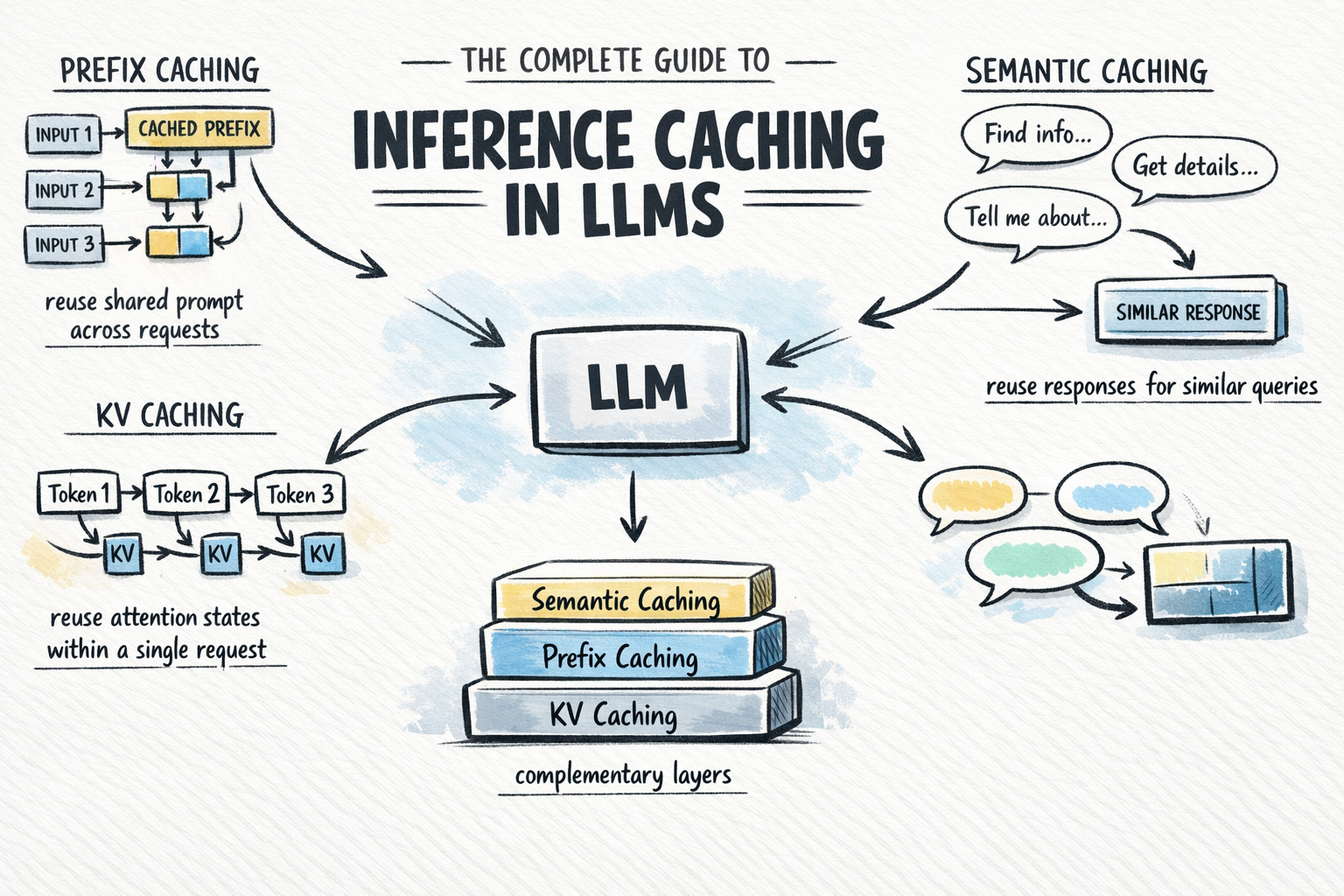
The Complete Guide to Inference Caching in LLMs
Image by Author
Introduction
Calling a large language model API at scale is expensive and slow. A significant share of that cost comes from repeated computation: the same system prompt processed from scratch on every request, and the same common queries answered as if the model has never seen them before. Inference caching addresses this by storing the results of expensive LLM computations and reusing them when an equivalent request arrives.
Depending on which caching layer you apply, you can skip redundant attention computation mid-request, avoid reprocessing shared prompt prefixes across requests, or serve common queries from a lookup without invoking the model at all. In production systems, this can significantly reduce token spend with almost no change to application logic.
This article covers:
- What inference caching is and why it matters
- The three main caching types: key-value (KV), prefix, and semantic caching
- How semantic caching extends coverage beyond exact prefix matches
Each section builds toward a practical decision framework for choosing the right caching strategy for your application.
What Is Inference Caching?
When you send a prompt to a large language model, the model performs a substantial amount of computation to process the input and generate each output token. That computation takes time and costs money. Inference caching is the practice of storing the results of that computation — at various levels of granularity — and reusing them when a similar or identical request arrives.
There are three distinct types to understand, each operating at a different layer of the stack:
- KV caching: Caches the internal attention states — key-value pairs — computed during a single inference request, so the model does not recompute them at every decode step. This happens automatically inside the model and is always on.
- Prefix caching: Extends KV caching across multiple requests. When different requests share the same leading tokens, such as a system prompt, a reference document, or few-shot examples, the KV states for that shared prefix are stored and reused across all of them. You may also see this called prompt caching or context caching.
- Semantic caching: A higher-level, application-side cache that stores complete LLM input/output pairs and retrieves them based on semantic similarity. Unlike prefix caching, which operates on attention states mid-computation, semantic caching short-circuits the model call entirely when a sufficiently similar query has been seen before.
These are not interchangeable alternatives. They are complementary layers. KV caching is always running. Prefix caching is the highest-leverage optimization you can add to most production applications. Semantic caching is a further enhancement when query volume and similarity are high enough to justify it.
Understanding How KV Caching Works
KV caching is the foundation that everything else builds on. To understand it, you need a brief look at how transformer attention works during inference.
The Attention Mechanism and Its Cost
Modern LLMs use the transformer architecture with self-attention. For every token in the input, the model computes three vectors:
- Q (Query) — What is this token looking for?
- K (Key) — What does this token offer to other tokens?
- V (Value) — What information does this token carry?
Attention scores are computed by comparing each token’s query against the keys of all previous tokens, then using those scores to weight the values. This allows the model to understand context across the full sequence.
LLMs generate output autoregressively — one token at a time. Without caching, generating token N would require recomputing K and V for all N-1 previous tokens from scratch. For long sequences, this cost compounds with every decode step.
How KV Caching Fixes This
During a forward pass, once the model computes the K and V vectors for a token, those values are saved in GPU memory. For each subsequent decode step, the model looks up the stored K and V pairs for the existing tokens rather than recomputing them. Only the newly generated token requires fresh computation. Here is a simple example:
|
1 2 3 4 5 |
Without KV caching (generating token 100): Recompute K, V for tokens 1–99 → then compute token 100 With KV caching (generating token 100): Load stored K, V for tokens 1–99 → compute token 100 only |
This is KV caching in its original sense: an optimization within a single request. It is automatic and universal; every LLM inference framework enables it by default. You do not need to configure it. However, understanding it is essential for understanding prefix caching, which extends this mechanism across requests.
For a more thorough explanation, see KV Caching in LLMs: A Guide for Developers.
Using Prefix Caching to Reuse KV States Across Requests
Prefix caching — also called prompt caching or context caching depending on the provider — takes the KV caching concept one step further. Instead of caching attention states only within a single request, it caches them across multiple requests — specifically for any shared prefix those requests have in common.
The Core Idea
Consider a typical production LLM application. You have a long system prompt — instructions, a reference document, and few-shot examples — that is identical across every request. Only the user’s message at the end changes. Without prefix caching, the model recomputes the KV states for that entire system prompt on every call. With prefix caching, it computes them once, stores them, and every subsequent request that shares that prefix skips directly to processing the user’s message.
The Hard Requirement: Exact Prefix Match
Prefix caching only works when the cached portion of the prompt is byte-for-byte identical. A single character difference — a trailing space, a changed punctuation mark, or a reformatted date — invalidates the cache and forces a full recomputation. This has direct implications for how you structure your prompts.
Place static content first and dynamic content last. System instructions, reference documents, and few-shot examples should lead every prompt. Per-request variables — the user’s message, a session ID, or the current date — should appear at the end.
Similarly, avoid non-deterministic serialization. If you inject a JSON object into your prompt and the key order varies between requests, the cache will never hit, even when the underlying data is identical.
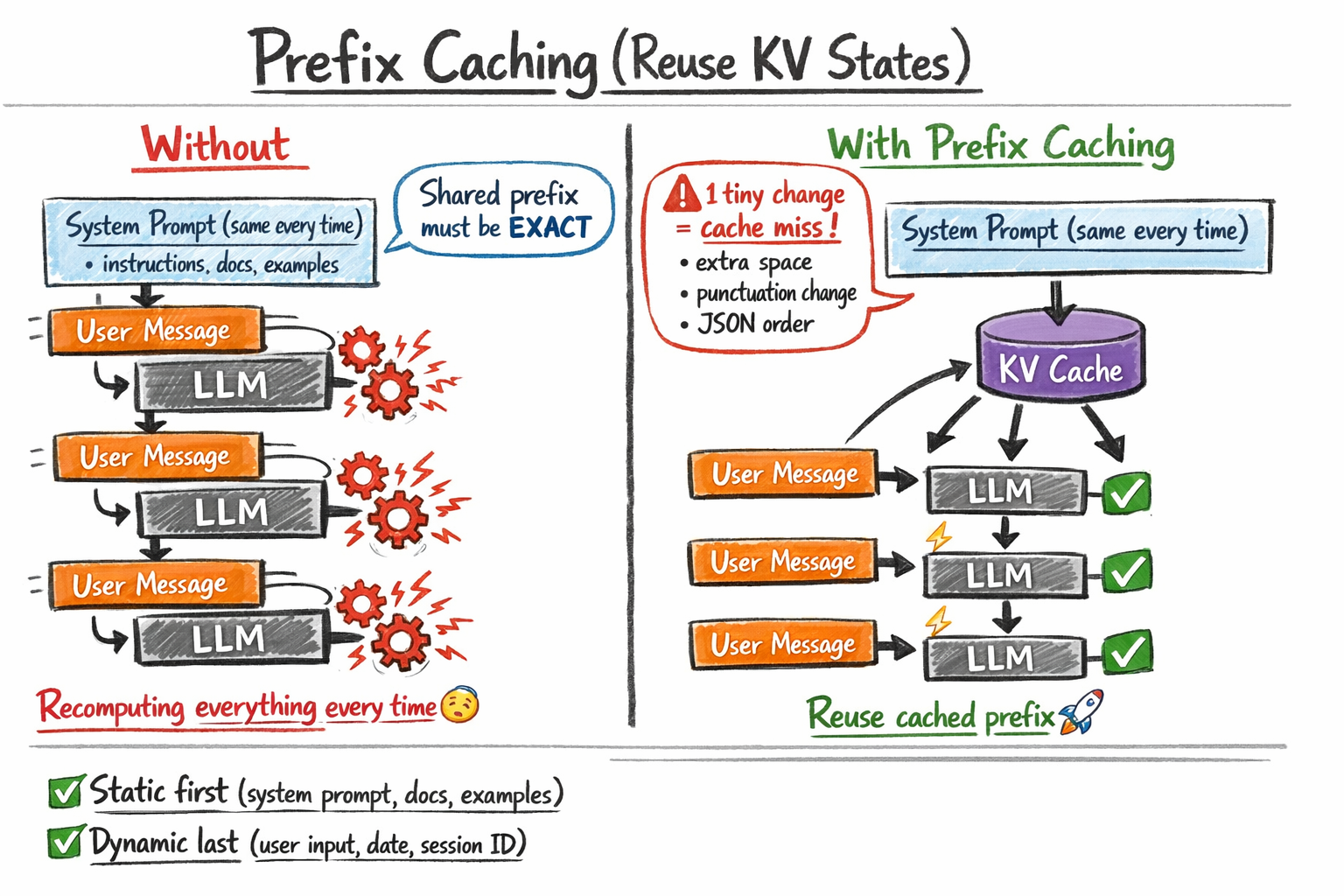
How prefix caching works
Provider Implementations
Several major API providers expose prefix caching as a first-class feature.
Anthropic calls it prompt caching. You opt in by adding a cache_control parameter to the content blocks you want cached. OpenAI applies prefix caching automatically for prompts longer than 1024 tokens. The same structural rule applies: the cached portion must be the stable leading prefix of your prompt.
Google Gemini calls it context caching and charges for stored cache separately from inference. This makes it most cost-effective for very large, stable contexts that are reused many times across requests.
Open-source frameworks like vLLM and SGLang support automatic prefix caching for self-hosted models, managed transparently by the inference engine without any changes to your application code.
Understanding How Semantic Caching Works
Semantic caching operates at a different layer: it stores complete LLM input/output pairs and retrieves them based on meaning, not exact token matches.
The practical difference is significant. Prefix caching makes processing a long shared system prompt cheaper on every request. Semantic caching skips the model call entirely when a semantically equivalent query has already been answered, regardless of whether the exact wording matches.
Here is how semantic caching works in practice:
- A new query arrives. Compute its embedding vector.
- Search a vector store for cached entries whose query embeddings exceed a cosine similarity threshold.
- If a match is found, return the cached response directly without calling the model.
- If no match is found, call the LLM, store the query embedding and response in the cache, and return the result.
In production, you can use vector databases such as Pinecone, Weaviate, or pgvector, and apply an appropriate TTL so stale cached responses do not persist indefinitely.
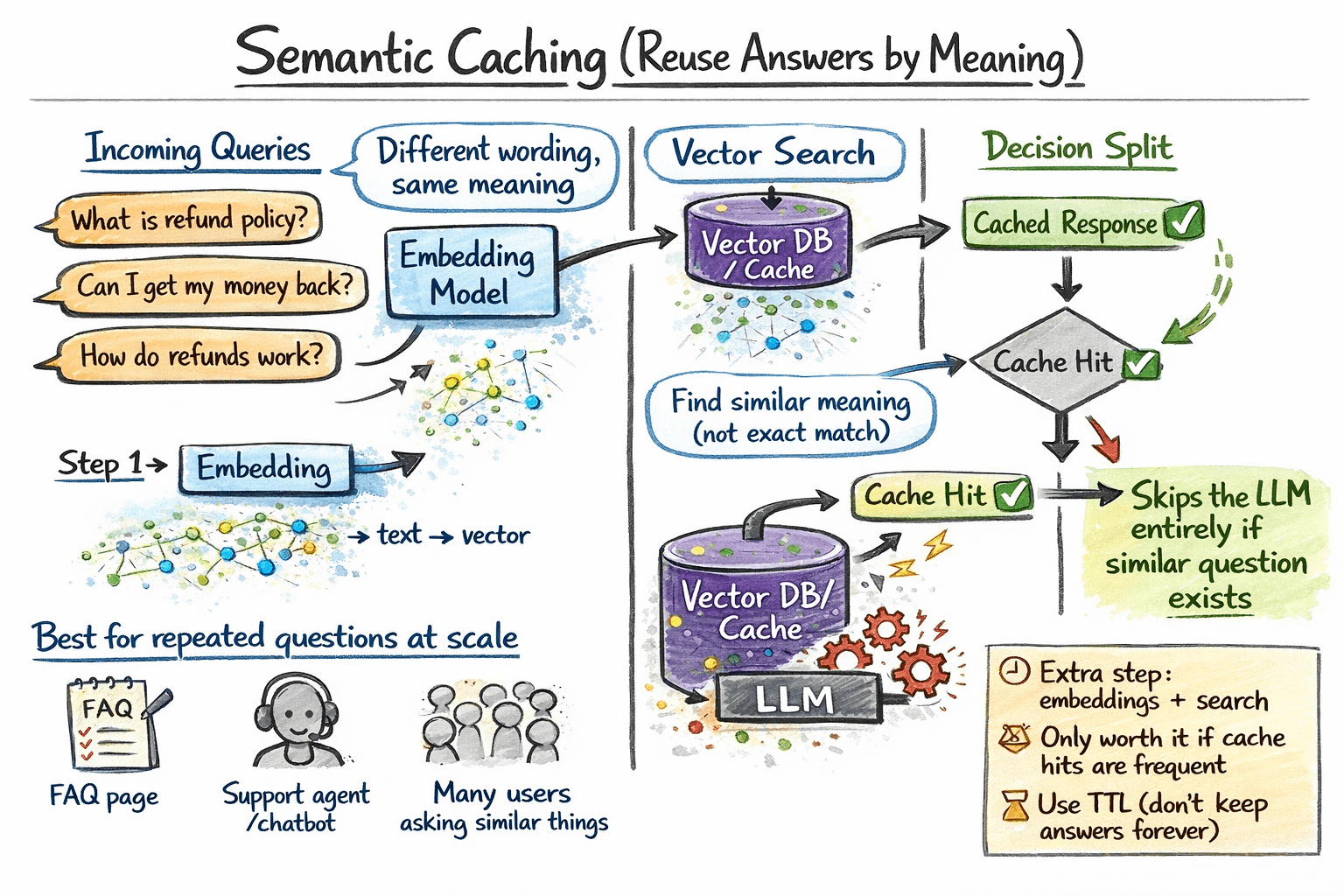
How semantic caching works
When Semantic Caching Is Worth the Overhead
Semantic caching adds an embedding step and a vector search to every request. That overhead only pays off when your application has sufficient query volume and repeated questions such that the cache hit rate justifies the added latency and infrastructure. It works best for FAQ-style applications, customer support bots, and systems where users ask the same questions in slightly different ways at high volume.
Choosing The Right Caching Strategy
These three types operate at different layers and solve different problems.
| USE CASE | CACHING STRATEGY |
|---|---|
| All applications, always | KV caching (automatic, nothing to configure) |
| Long system prompt shared across many users | Prefix caching |
| RAG pipeline with large shared reference documents | Prefix caching for the document block |
| Agent workflows with large, stable context | Prefix caching |
| High-volume application where users paraphrase the same questions | Semantic caching |
The most effective production systems layer these strategies. KV caching is always running underneath. Add prefix caching for your system prompt — this is the highest-leverage change for most applications. Layer semantic caching on top if your query patterns and volume justify the additional infrastructure.
Conclusion
Inference caching is not a single technique. It is a set of complementary tools that operate at different layers of the stack:
- KV caching runs automatically inside the model on every request, eliminating redundant attention recomputation during the decode stage.
- Prefix caching, also called prompt caching or context caching, extends KV caching across requests so a shared system prompt or document is processed once, regardless of how many users access it.
- Semantic caching sits at the application layer and short-circuits the model call entirely for semantically equivalent queries.
For most production applications, the first and highest-leverage step is enabling prefix caching for your system prompt. From there, add semantic caching if your application has the query volume and user patterns to make it worthwhile.
As a concluding note, inference caching stands out as a practical way to improve large language model performance while reducing costs and latency. Across the different caching techniques discussed, the common theme is avoiding redundant computation by storing and retrieving prior results where possible. When applied thoughtfully — with attention to cache design, invalidation, and relevance — these techniques can significantly enhance system efficiency without compromising output quality.




Well done. Appreciate the article. Clear and easy to understand. Thanks for your expertise and time.
Thank you Lee for your feedback!
Great article. Has all the important concepts in one place.
Thank you for your feedback Abhinav! We appreciat it!