
In this article, you will learn what the major AI agent benchmarks measure, how they differ from traditional model benchmarks, and how to use them as directional signals rather than performance guarantees.
Topics we will cover include:
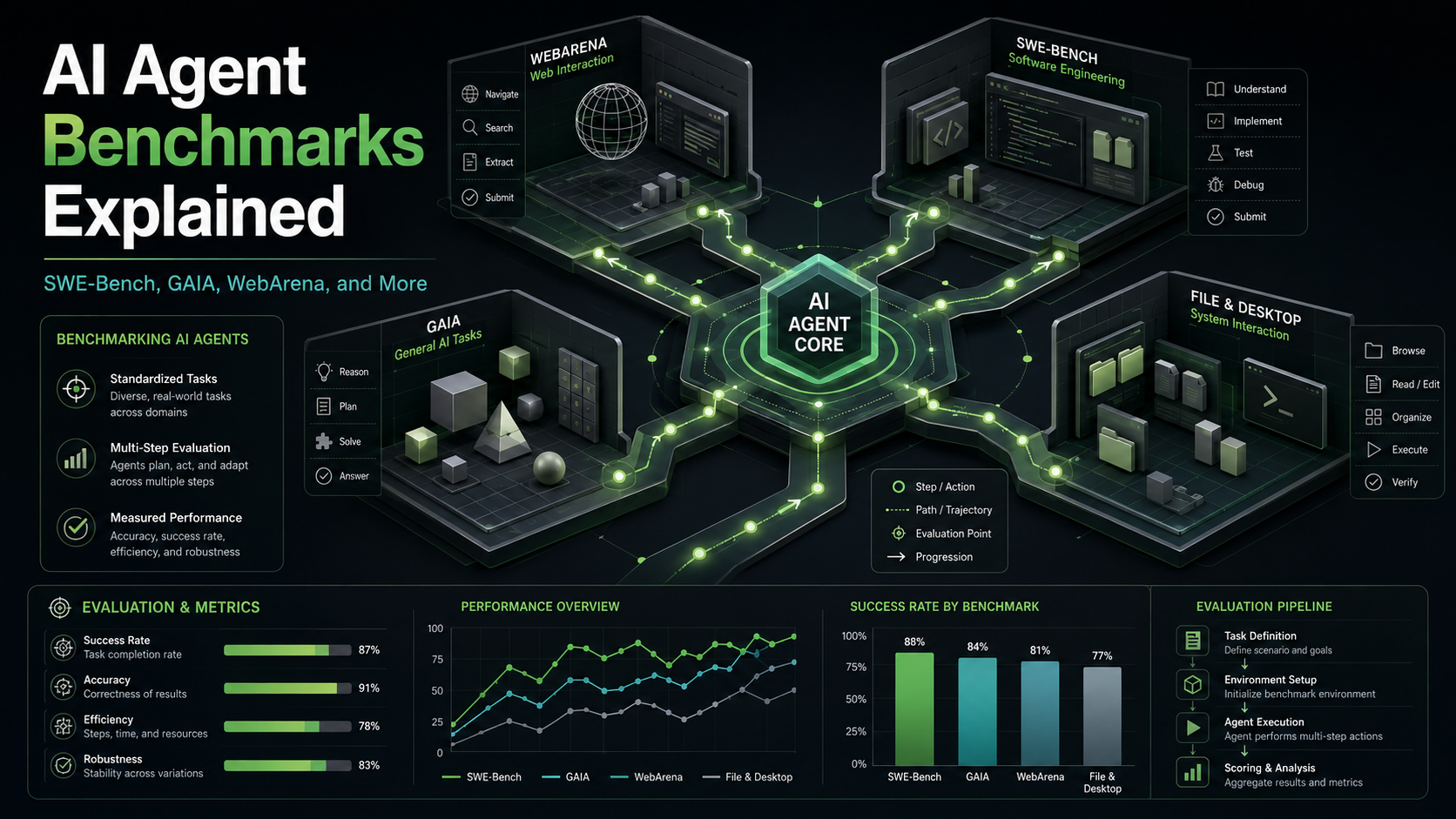
- How agent benchmarks like SWE-Bench, GAIA, WebArena, and OSWorld differ from one another and what each one actually tests.
- What leaderboard scores consistently leave out, including cost, latency, safety, and error recovery.
- How to combine public benchmarks with private evaluations to make more reliable decisions about agent deployment.
Introduction
Every AI provider claims their agent is state of the art. Leaderboards update weekly. Marketing pages glow with impressive percentages. But for anyone who has actually deployed an AI agent in production, one question matters more than any score: does it reliably do the job you hired it for?
This guide cuts through the leaderboard noise. You’ll learn what the major AI agent benchmarks actually measure, why each one captures only a slice of real-world capability, and how to use these evaluations as directional signals rather than performance guarantees.
Agent Benchmarks vs. Model Benchmarks
Before examining specific evaluations, it helps to understand what separates an agent benchmark from a standard model benchmark.
Traditional benchmarks like MMLU or HumanEval test a model’s ability to generate a correct response in a single turn. You ask a question, the model answers, and a judge scores the output. These tests are useful for measuring raw language understanding and reasoning, but they say nothing about whether a system can navigate the real world.
Agent benchmarks introduce a categorically different challenge. They drop a model into an environment where it must take sequences of actions over multiple steps, use external tools, adapt when something goes wrong, and ultimately achieve a goal that can’t be reached in one response. The model might browse websites, write and execute code, click through interfaces, or manipulate files. Failure isn’t just a wrong answer — it might be a stuck loop, a broken workflow, or a task abandoned halfway through.
The contrast is stark: a traditional benchmark is a written exam. An agent benchmark is a live work simulation where the candidate must navigate real tools, real friction, and real surprises. With that distinction in mind, let’s walk through the major evaluations and what each one actually tests.
The Major Benchmarks, Explained
SWE-Bench and SWE-Bench Verified
SWE-bench is the closest thing to a gold standard for software engineering agents. It presents the agent with a real GitHub issue drawn from popular Python repositories, including projects like Django and scikit-learn, and asks the agent to produce a code patch that resolves the problem. Success is measured by whether the patch passes the repository’s existing unit tests.
SWE-bench Verified is a curated subset where human engineers have confirmed that each task is genuinely solvable and that the unit tests accurately reflect whether the fix worked. This addresses a real weakness of the original benchmark: some tasks were ambiguous or had flawed test suites that could pass with incorrect solutions.
The catch is worth understanding. Passing a unit test suite is not the same as writing good code. An agent can produce a patch that technically passes every test while simultaneously introducing a memory leak, creating a security vulnerability, or solving only a narrow edge case while breaking three others. SWE-bench measures whether an agent can satisfy a specific, automated criterion — it doesn’t measure code quality, maintainability, or safety. With that limitation in mind, let’s look at a benchmark targeting a very different capability.
GAIA
GAIA, which stands for General AI Assistants, targets the ability to answer complex questions that require reasoning across multiple tools and modalities. A GAIA task might ask an agent to look up a document, cross-reference it with information from the web, perform a calculation, and synthesize a final answer.
What makes GAIA distinctive is that its questions are designed to be trivially easy for a human with internet access but genuinely difficult for current AI systems. The benchmark tests whether an agent can coordinate web browsing, file handling, and multi-step deduction in the right sequence without losing track of the original goal.
The limitation is that GAIA tasks, by design, tend to have single correct answers. Real assistant workflows are messier: goals shift, instructions are ambiguous, and the right answer often depends on context that an agent can’t retrieve from a search engine. From reasoning and retrieval, we can move to a benchmark that focuses squarely on something most agents encounter daily: the web browser.
WebArena and BrowserGym
WebArena tests whether an agent can navigate realistic web applications to complete multi-step tasks. Rather than using live websites, it spins up sandboxed versions of e-commerce platforms, content management systems, forums, and other common web environments. The agent must interact with these interfaces the way a human would: clicking buttons, filling out forms, navigating menus, and interpreting page content.
BrowserGym extends this into a more modular framework, allowing researchers to plug in different web environments and evaluation criteria. Together, these benchmarks are the best current tools for evaluating browser-based agents.
The contamination problem looms large here. Many of WebArena’s original tasks have been in circulation long enough that they may appear in the training data of newer models. A high score could reflect genuine capability or pattern-matching against memorized task structures. Researchers and vendors rarely disclose how thoroughly they’ve checked for this. If WebArena represents the browser, the final benchmark takes things a step further, handing the agent an entire computer.
OSWorld
OSWorld takes the most expansive view of agent capability. It places an agent inside a sandboxed desktop operating system and tasks it with completing real computer-use workflows: manipulating files, navigating GUI applications, adjusting system settings, and coordinating across multiple programs.
This benchmark is the most ambitious in scope because it mirrors how a human assistant would actually operate a computer. It’s also the most fragile. If the simulated operating system crashes, the display renders incorrectly, or an application behaves unexpectedly, the agent fails even when its reasoning was sound. OSWorld scores are therefore heavily dependent on the stability of the infrastructure running the evaluation, not just the capability of the model being tested.
What Leaderboards Don’t Show
Now that we’ve covered what each benchmark measures, it’s worth stepping back to examine what all of them miss. Benchmark scores are designed to be comparable across systems, which is useful, but it also means they systematically exclude the things that are hardest to standardize and most important in production.
Cost and efficiency. An agent that scores 80% on SWE-bench might achieve that by exhaustively trying dozens of approaches, burning through enormous numbers of tokens and API calls along the way. Another agent scoring 70% might reach its solutions in a fraction of the compute. Leaderboards show success rates, not bills.
Latency. Whether a task takes thirty seconds or twenty minutes matters for both user experience and infrastructure costs. No major benchmark ranks agents on speed.
Safety and boundary-following. An agent should know what it’s not supposed to do. Does it respect permissioning boundaries? Does it refuse to take destructive actions when uncertain? Does it ask for clarification rather than guessing on high-stakes decisions? None of the leading benchmarks evaluate this consistently.
Error recovery. The most revealing test of an agent is not how it performs when everything works. It’s how it responds when it hits a broken link, an unexpected interface, or a failing subprocess. Some benchmarks include partial credit for recovery, but this dimension is largely underrepresented across the field.
Automated grading noise. Many evaluations use another language model to score whether an agent’s output was correct. This introduces its own failure mode: a confident-sounding but wrong answer can fool an automated grader, inflating scores in ways that wouldn’t survive human review.
Using Benchmarks Wisely
With a clearer picture of what benchmarks can and can’t tell you, the question becomes how to use them productively.
Public benchmarks are genuinely useful for narrowing down which agent architectures are worth exploring. A system that scores near zero on SWE-bench isn’t ready for a software engineering workflow. A system that struggles on GAIA is unlikely to handle complex research tasks reliably. These evaluations can eliminate options and surface candidates worth investigating further.
The mistake is treating benchmark scores as predictions of production performance. The gap between a controlled test environment and a live workflow is wide. Tasks in production are messier, goals are less precisely defined, and the consequences of failure are real.
The most reliable approach is to use public benchmarks as a first filter, then build private evaluations designed around your specific workflows. If your agent will be booking travel, test it on booking travel. If it will be summarizing contracts, evaluate it on contracts that resemble yours. The task you care about, run in conditions that approximate your environment, is the only benchmark that tells you what you actually need to know.
Conclusion
AI agent benchmarks like SWE-bench, GAIA, WebArena, and OSWorld represent genuine progress in evaluating autonomous systems. Each one illuminates a real dimension of capability. None of them tells the whole story. Understanding what each benchmark measures, and where each one breaks down, is what separates teams that deploy agents confidently from teams that are surprised by production failures. Use the leaderboards to start the conversation. Build your own evaluations to finish it.


No comments yet.