
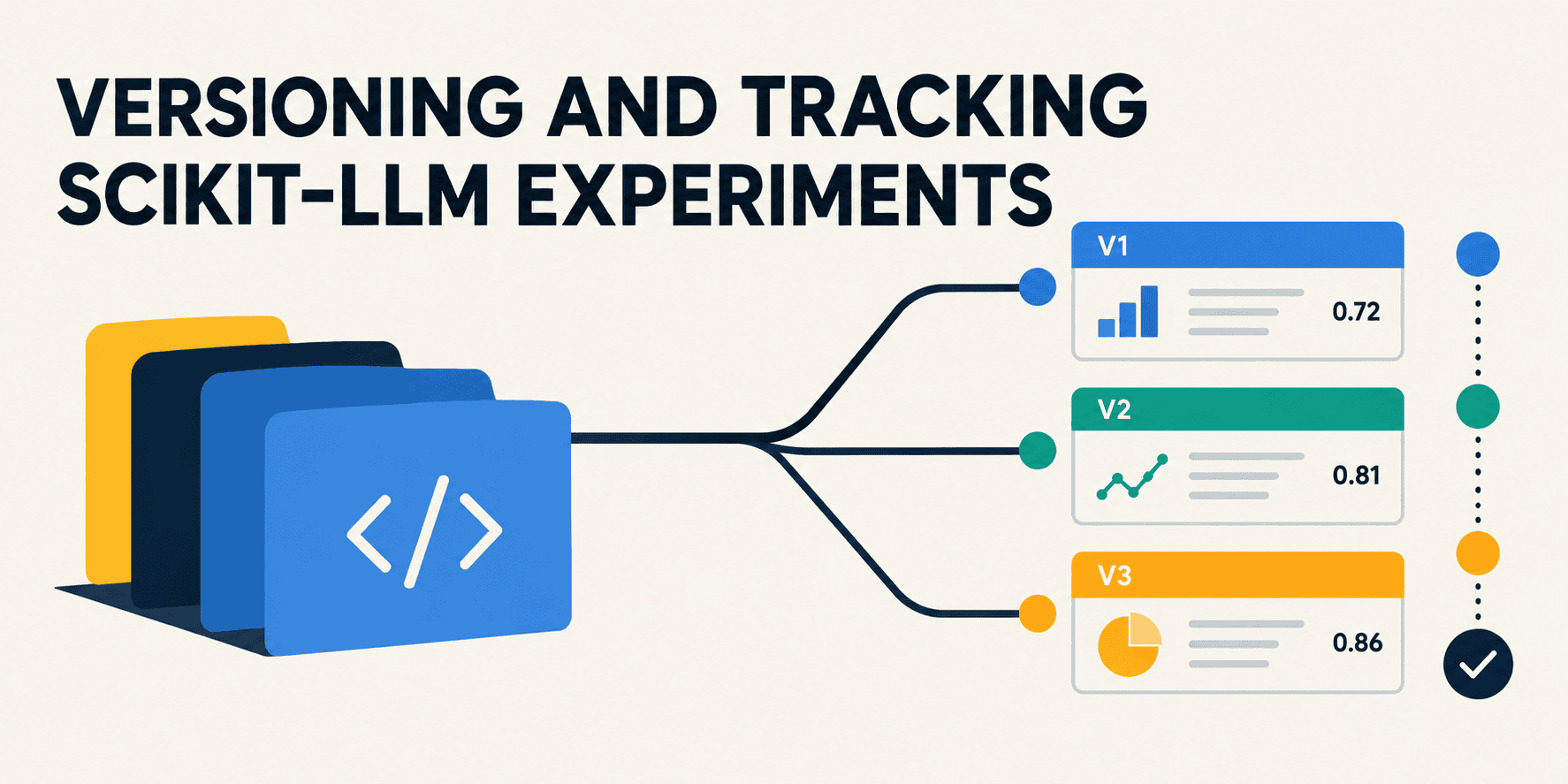
In this article, you will learn how to build, track, compare, and register scikit-learn pipelines that integrate large language models using Scikit-LLM and MLflow.
Topics we will cover include:
- How to configure Scikit-LLM and MLflow to support local large language model execution and experiment tracking.
- How to log multiple pipeline versions across different large language model backends and compare them using MLflow’s tracking API.
- How to promote the best-performing pipeline from a tracked experiment into MLflow’s Model Registry for deployment.
Introduction
Registering, versioning, and comparing scikit-learn-like pipelines that integrate large language models (LLMs) can be made easy with the aid of two cornerstone tools: the Scikit-LLM library and MLflow, an open-source framework for managing the end-to-end lifecycle of machine learning projects.
This article demonstrates the steps to build, log, compare, and register scikit-learn pipelines revolving around LLMs using Scikit-LLM and MLflow. The code shown and described in detail below is designed with the primary purpose of ensuring model versioning and reproducibility across LLM backend updates — a frequent process in real settings that can quickly escalate.
Setup and Initial Configurations
If you haven’t done so before, or if you are running this code on a cloud-based notebook like Google Colab, the first step is to install the key libraries you will need:
|
1 |
pip install "scikit-llm[gpt4all]" mlflow |
Make sure to use the extra option in brackets when installing scikit-llm to avoid compatibility issues.
Now, we initialize the configuration of Scikit-LLM with dummy credentials that enable local gpt4all model execution. Meanwhile, the MLflow model registry —the key resource where models will be versioned— relies on a database backend, which is also configured in the code below. Moreover, we initialize an MLflow tracking experiment named "Scikit-LLM-Versioning". Lastly, we define a small labeled dataset for zero-shot classification (more about this LLM-driven form of classification task here).
|
1 2 3 4 5 6 7 8 9 10 11 12 13 14 15 16 17 18 19 20 21 |
import mlflow import mlflow.sklearn from sklearn.pipeline import Pipeline from skllm.config import SKLLMConfig from skllm.models.gpt.classification.zero_shot import ZeroShotGPTClassifier # 1. Dummy keys required by Scikit-LLM for local gpt4all execution SKLLMConfig.set_openai_key("local-execution-key") SKLLMConfig.set_openai_org("local-execution-org") # 2. Database backend required for the MLflow Model Registry mlflow.set_tracking_uri("sqlite:///mlflow.db") mlflow.set_experiment("Scikit-LLM-Versioning") # Sample dataset for zero-shot classification X_train = [ "The application crashed immediately.", "Absolutely wonderful support team!", "It works fine but is a bit slow." ] y_train = ["bug", "praise", "feedback"] |
Logging the Baseline and Upgraded Pipelines
This is where the real fun starts. We initialize a baseline pipeline that trains a zero-shot classification model using a lightweight pre-trained LLM.
The with block that follows, named after the Orca Mini model selected, enables tracking of the LLM backend type and the model file string as environment parameters, thereby fostering reproducibility. A "cloudpickle" serialization format (a variant of the classic pickle, or .pkl for short, used in smaller machine learning models) is used to log the pipeline. Understanding this block is key to leveraging LLM versioning in MLflow for subsequent experiment tracking. Once execution completes, it outputs a unique MLflow run ID.
|
1 2 3 4 5 6 7 8 9 10 11 12 13 14 15 16 17 18 19 20 |
LLM_V1 = "gpt4all::orca-mini-3k-71m-q4_0.gguf" pipeline_v1 = Pipeline([ ('llm_classifier', ZeroShotGPTClassifier(model=LLM_V1)) ]) with mlflow.start_run(run_name="Baseline_Orca_Mini") as run_v1: mlflow.log_param("llm_backend", "gpt4all") mlflow.log_param("llm_model_file", LLM_V1) pipeline_v1.fit(X_train, y_train) # Override strict skops type checking with cloudpickle mlflow.sklearn.log_model( pipeline_v1, "model", serialization_format="cloudpickle" ) print(f"V1 Logged - Run ID: {run_v1.info.run_id}") |
Output excerpt:
|
1 |
V1 Logged - Run ID: 0852aaec23364725b433f09973a3d911 |
Next, let’s suppose we create a secondary, upgraded pipeline based on a heavier LLM to demonstrate MLflow’s model-swapping capabilities. Specifically, we now target "gpt4all::ggml-model-gpt4all-falcon-q4_0.bin", which makes for a realistic backend upgrade. The code below isolates this new pipeline inside a separate MLflow run named "Upgraded_Falcon". Everything else is done just as before: pipeline parameterization, model fitting, and logging —just in a distinct MLflow run, yielding a new unique ID.
|
1 2 3 4 5 6 7 8 9 10 11 12 13 14 15 16 17 18 19 20 |
LLM_V2 = "gpt4all::ggml-model-gpt4all-falcon-q4_0.bin" pipeline_v2 = Pipeline([ ('llm_classifier', ZeroShotGPTClassifier(model=LLM_V2)) ]) with mlflow.start_run(run_name="Upgraded_Falcon") as run_v2: mlflow.log_param("llm_backend", "gpt4all") mlflow.log_param("llm_model_file", LLM_V2) pipeline_v2.fit(X_train, y_train) # Override strict skops type checking with cloudpickle mlflow.sklearn.log_model( pipeline_v2, "model", serialization_format="cloudpickle" ) print(f"V2 Logged - Run ID: {run_v2.info.run_id}") |
Output excerpt:
|
1 |
V2 Logged - Run ID: ee892572d0a641f89201c33479b98746 |
Auditing, Comparing, and Registering Models
Now that we have multiple logged pipeline versions, we invoke the MLflow search API to extract the full versioning experiment and display it as a pandas DataFrame. Note that key auditing columns have been separated for clarity: run ID, MLflow run name, local LLM parameter, and execution status. For a realistic touch, the results below (based on previous runs leading to the final code included in this article) show historical audit information from several executions — displaying not only MLflow tracking of FINISHED pipelines but also early FAILED attempts.
|
1 2 3 4 5 6 7 |
experiment = mlflow.get_experiment_by_name("Scikit-LLM-Versioning") runs_df = mlflow.search_runs(experiment.experiment_id) comparison_df = runs_df[['run_id', 'tags.mlflow.runName', 'params.llm_model_file', 'status']] print("Experiment Tracking Audit:") display(comparison_df) |
|
1 2 3 4 5 6 |
run_id tags.mlflow.runName params.llm_model_file status 0 ee892572d0a641f89201c33479b98746 Upgraded_Falcon gpt4all::ggml-model-gpt4all-falcon-q4_0.bin FINISHED 1 0852aaec23364725b433f09973a3d911 Baseline_Orca_Mini gpt4all::orca-mini-3k-71m-q4_0.gguf FINISHED 2 68781001dec14e0cbe46e71cf38e92c4 Upgraded_Falcon gpt4all::ggml-model-gpt4all-falcon-q4_0.bin FINISHED 3 37e6011d2cca4e43a0a426cb936582e6 Baseline_Orca_Mini gpt4all::orca-mini-3k-71m-q4_0.gguf FINISHED 4 5ccd7e21a74a4fcc8a01633231417b28 Baseline_Orca_Mini gpt4all::orca-mini-3k-71m-q4_0.gguf FAILED |
Note that if you run the provided code and all cells execute without errors, you may see a shorter list — ideally containing only two logged runs associated with the two pipelines, both with FINISHED status.
To wrap up, let’s shift from logged to registered. In other words, let’s see how to extract the optimal execution run and promote (formally register) its associated model into MLflow’s Model Registry. The code searches the DataFrame to find the first run matching the "Upgraded_Falcon" label and secures its run ID. This target pipeline is then registered in the backend database, officially recorded as Version 1.
|
1 2 3 4 5 6 7 8 9 10 |
best_run_id = runs_df[runs_df['tags.mlflow.runName'] == 'Upgraded_Falcon'].iloc[0]['run_id'] model_uri = f"runs:/{best_run_id}/model" registered_model = mlflow.register_model( model_uri=model_uri, name="Production_ZeroShot_Classifier" ) print(f"Successfully registered model '{registered_model.name}'") print(f"Current Registry Version: {registered_model.version}") |
Output:
|
1 2 |
Successfully registered model 'Production_ZeroShot_Classifier' Current Registry Version: 1 |
We just performed a hardcoded, manual model selection, but what if you want to find and register the one with the best performance — for instance, the highest accuracy? You could do something like this before calling mlflow.register_model():
|
1 2 3 4 5 6 7 8 9 |
# Retrieving runs ordered by accuracy (highest to lowest) best_runs_df = mlflow.search_runs( experiment_ids=[experiment.experiment_id], order_by=["metrics.accuracy DESC"] ) # Extracting the ID of the absolute top performer metric_winner_id = best_runs_df.iloc[0] print(metric_winner_id) |
Output:
|
1 2 3 4 5 6 7 8 9 10 11 12 |
run_id 0605f300074a4d91b1e3438348d157f1 experiment_id 1 status FINISHED artifact_uri /content/mlruns/1/0605f300074a4d91b1e3438348d1... start_time 2026-08-29 14:53:18.182000+00:00 end_time 2026-08-29 14:53:22.007000+00:00 params.llm_model_file gpt4all::ggml-model-gpt4all-falcon-q4_0.bin params.llm_backend gpt4all tags.mlflow.source.name fileId=1GM67JQ61d3Y7eibN63YS6Udjt5qxf14x tags.mlflow.runName Upgraded_Falcon tags.mlflow.user root tags.mlflow.source.type NOTEBOOK |
Wrapping Up
The two-step (logging and registering) workflow for LLM pipeline versioning introduced in this article is designed to prevent your official model registry from becoming cluttered with failed attempts, messy code excerpts, or inferior test runs that led nowhere. The tracking table displaying logged versions is used to compare a set of rough drafts, publishing only the final “winner(s)” to the registry database for deployment or active use.





No comments yet.