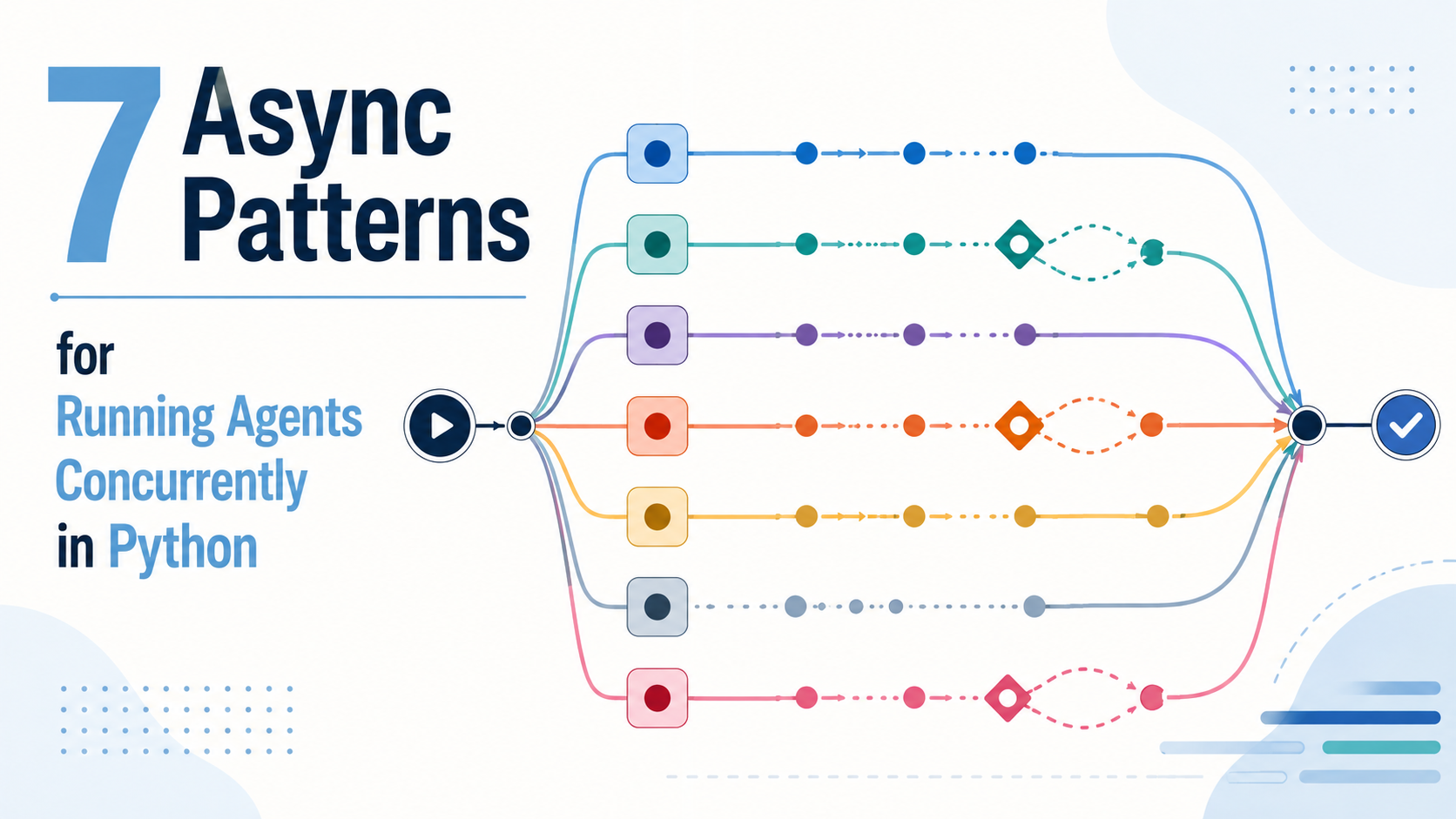
In this article, you will learn seven async patterns for running AI agents concurrently in Python, what each pattern is suited for, and the production-level pitfalls to watch out for with each.
Topics we will cover include:
Core async patterns such as fire and forget, scatter-gather, task groups, and producer-consumer queues, and when to reach for each one.
Resource-management techniques including semaphore-based backpressure and speculative execution, along with their real-world trade-offs.
How to chain agents into asynchronous pipelines and keep your event loop healthy under load.
Orchestrating a single AI agent is simple enough. Keeping a fleet of them running concurrently without deadlocking your event loop or triggering cascading rate limit errors is a different problem entirely.
Python’s asyncio library gives you the primitives to manage this. But the patterns you reach for matter. Each one solves a different coordination problem, and picking the wrong one creates failure modes that are slow to surface and hard to debug.
Here are seven async patterns for running agents concurrently, along with the production catches that come with each.
1. Fire and Forget (Detached Background Execution)
You launch an agent task and move on without waiting for it to finish. The coroutine runs in the background while your main execution path continues.
This works well when the task outcome doesn’t affect anything downstream: logging, flushing context to storage, or triggering a background cleanup agent.
Watch out for: Exceptions in detached tasks are silently swallowed by the event loop. If a background agent fails, nothing alerts you unless you explicitly attach an error callback. Wire in exception handling before treating any task as truly safe to ignore.
2. Strict Scatter-Gather
You fan out from one orchestrator agent to multiple worker agents simultaneously, then wait for all of them to return before continuing.
asyncio.gather() multiplexes outbound requests and assembles results in launch order. Think five agents querying different data sources in parallel, with results collected once the last one finishes.
Watch out for: By default, a single failure cancels the rest. Even when you disable that behavior, straggler latency still applies — the whole operation waits on the slowest agent. One slow generation bottlenecks everything else.
3. Supervised Task Groups
Introduced in Python 3.11, task groups give you a structured version of gather. A context manager makes the scope of concurrent tasks explicit: when the block exits, all tasks are either complete or cancelled, and errors surface immediately.
For new projects on Python 3.11+, task groups are generally the cleaner choice over managing a loose collection of tasks manually.
Watch out for: Task groups aggressively cancel sibling tasks on failure. If one worker hits a rate limit error, every other running agent gets cancelled. Build retry logic inside individual agent coroutines before letting exceptions reach the group level.
4. Producer-Consumer with Queues
Not all agents start at the same time. Sometimes one agent generates work and others process it, and a queue sits between them as a buffer.
Producer agents add items to the queue as they find work. Consumer agents pull from it independently. The two sides don’t need to know anything about each other, and you can scale consumers up or down without touching the producer.
Watch out for: Unbounded queues leak memory silently. If your producer generates tasks faster than consumers can process them, the queue grows until your process runs out of RAM. Set a maximum queue size to enforce backpressure on the producer.
5. Backpressure via Semaphores
You set a hard limit on how many agents can access a resource at the same time. Agents that exceed the limit wait their turn rather than all firing simultaneously.
This is one of the most practical patterns for production agent systems, where external APIs, database connection pools, and internal services all have throughput ceilings.
Watch out for: Semaphores limit connections, not tokens. You can cap concurrent requests at 10 and still blow through a provider’s tokens-per-minute limit if all 10 agents are generating large outputs at once. For strict API compliance, pair semaphores with token-aware throttling.
6. Speculative Execution (First Completed Wins)
You race multiple agents against the same goal and cancel the losers the moment one returns a valid result. This trades compute efficiency for speed.
A common use case is racing a smaller, faster model against a larger, slower one and accepting whichever finishes within your latency target.
Watch out for: Cancelling a task drops your local connection but doesn’t stop generation on the provider’s servers. The model keeps running and consuming tokens on your account even after you’ve moved on. You pay for every losing agent, every time.
7. Asynchronous Pipeline Chaining
Each agent in a chain takes the output of the previous one as input. Agent A fetches raw data, Agent B cleans it, Agent C analyzes it, Agent D formats the output.
This maps well to multi-stage retrieval pipelines and reasoning workflows where each stage has a distinct responsibility, isolated error handling, and potentially different model settings.
Watch out for: Tracing failures back through the chain is hard without instrumentation. By the time Agent D crashes on a malformed input, the schema violation may have started in Agent A. Inject tracing identifiers into the payloads passed between stages.
Discussion
Here are some quick hits on choosing the right pattern:
Independent tasks, all needed: scatter-gather or task groups
Streaming or unknown-volume workloads: producer-consumer with a queue
External resources with rate limits: backpressure via semaphores
Speed over completeness: speculative execution
Sequential logic across specialized agents: pipeline chaining
Background tasks with no return value needed: fire and forget
Most production systems combine two or three of these. A pipeline might use semaphores inside each stage. A producer-consumer setup might use gather within each consumer pool.
One more thing: watching your event loop
Even with perfectly async networking, synchronous CPU-bound operations — such as heavy JSON parsing or running a tokenizer — will block the event loop. When the loop blocks, in-flight requests miss their timeout heartbeats and trigger cascading failures across your otherwise async architecture.
Profile your loop regularly and offload CPU-heavy operations to a thread pool when they show up as bottlenecks. The patterns above handle I/O-bound coordination. Keeping the loop clear is what makes them hold up.
Conclusion
These seven patterns give you a vocabulary for thinking about agent coordination before problems surface in production. Start with gather or task groups for simple cases, layer in semaphores and queues as complexity grows, and treat the “watch out for” notes as the parts most likely to cost you at scale.
The patterns are the architecture. Getting them right is what separates a fragile prototype from a system that stays up.



No comments yet.